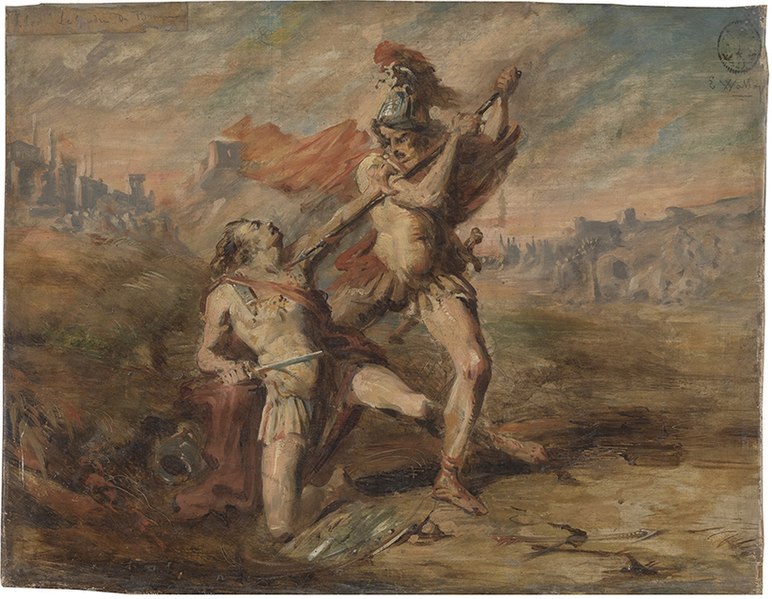
What do you think of when you hear the word “epic?” For many it’s just an adjective. For others, it’s Epic Games—the creators of Fortnite and other games. And for more, the first association is with epic fantasy, a portion of the modern fantasy genre focused on heroic tales of good and evil. These are all descendants of ancient epic literature.
There’s lots of reasons to read epic literature. It’s a cultural foundation stone second only to the Bible. It gives us a window into the past, into how people long ago thought and believed. Epic is used for history, for linguistics, for critical analysis, and more. And each of these uses misses the best reason of all to read epic.
It’s damn fun.
I love epic literature, and many people—often well-intended—miss why it’s great. Epic is not dull, dusty, and old-fashioned. It’s as bloodthirsty, tragic, and heartfelt as anything in modern literature or cinema. I get looks when I’m reading an epic, like people think I’ve got to be brilliant to understand it, or like only someone with academic training could make heads and tails of such a story. That’s just wrong. I read epic because I like stories about heroes having adventures. Epic is Die Hard, or Braveheart.
Here’s a passage from what I’m currently reading, the Aeneid:
“… a flash of his sword and he slices off Strymonius’ hand
just as it clutched his throat. He smashes Thoas full
in the face with a rock and crushes out his skull
in a spray of brains and blood.”
—Aeneid 10.489–10.493, trans. Fagles
Hollywood, eat your heart out!
The blinding of the cyclops Polyphemus, Hector’s somber funeral, the moral crisis of Arjuna, the swaggering arrogance of Gilgamesh—these moments aren’t plodding gasps of a poet. Epic isn’t a cultural foundation because it’s old. It’s a cultural foundation because it’s stories are good. And not just good in some literary critic, art-snob way. They’re fun. They’re enthralling. It’s not just “valid” to read epic like Conan the Barbarian. I encourage it!
These stories haven’t survived through centuries or millennia because they’re dull, but valuable. They survived because we kept translating them and telling them to one another. Generations have loved these books, and they’re still fantastic as a modern reader.
(Though I will admit getting a good translation helps. But that’s a topic for another day.)
In my experience, analysis and veneration is what kills epic. This applies to modern epic too. I adore Moby Dick, but if you made me sit through a whole class on that book I’d run it through a shredder. Moby Dick is great because everyone involved is completely nuts, and Melville’s overwriting lets you just sink into the crazy and watch it all unfold. Ancient epic is much the same way. If I tried to introduce you to epic by explaining who everyone is in the infamous “Catalogue of Ships” in the Iliad, you’d throw the book at my head. Hit a list of names, skim past and get back to the story. It won’t take long.
By venerating epic as something to be studied and revered, those of us who both study and like epic are killing its future.
If you’ve never read epic, go out and try it. Humanity’s greatest stories are available to everyone. End up disliking it? That’s OK too! Not everyone’s going to like epic, and that’s also great. I’m a firm believer that there’s something in epic for all types of readers, but I also don’t believe there’s a wrong way to read anything. There’s not something “wrong” or “stupid” about someone if they just plain don’t like a book.
Just try it. Please. If you like action, drama, romance—any of those basic elements of a story, you’ll find something to love.
Want to keep up-to-date on what Austin’s working on through Akhelas? Go ahead and sign up to the email list below. You’ll get a notification whenever a new post goes online. Interested in supporting his work? Back his Patreon for early articles, previews, behind-the-scenes data, and more.
You can also find Austin over on Facebook, and a bit more rarely on Twitter.
 Akhelas