Martin Helsdon’s second Gloranthan magnum opus combines two bodies of work into a single volume: the in-world fiction “A Periplus of Southern Genertela,” and the non-fiction treatise “Ships & Shores.” Due to the work’s length—nearly 400 pages—and variety, I’ve decided to review it in two parts.
(Fear not, I don’t intend this to be the norm. It feels gross and clickbait-y.)
This week focuses on the “Periplus. Next week will review “Ships & Shores,” as well as discuss how the two halves work together.
Without further ado, then, let’s cast away!
Disclaimer: I worked with this author in the past, on Men of the West. I was not involved in producing this volume, and I am reviewing a hardcover copy I purchased personally.
What’s Inside the Periplus?
“A Periplus of Southern Genertela” is an in-world text mostly written from the perspective of Rossvaran, a merchant of Rhigos in Esrolia. Of the 400-ish pages in Ships & Shores of Southern Genertela, 174 are dedicated to Rossvaran’s narrative. The story is organized into three large chunks detailing Rossvaran’s journeys:
- A circumnavigation of Choralinthor Bay which describes the ports and peoples of the Holy Country
- A journey to Dosakayo in the east, on the isle of Melib near Teshnos
- A journey to Noloswal in the west, along the coast of Seshnela
Several other locations are described during these sections (such as Skullport in the Three Step Isles). In addition, allusive fragments of “other scrolls” are presented which show scenes from “incomplete” sections of the Periplus. These fragments feel similar to the in-world texts which constitute Stafford’s King of Sartar.
Rossvaran’s Periplus is directly inspired by an ancient merchant’s guidebook, the Periplus of the Erythraean Sea from circa 50 AD. While I’ve not read that work myself, I have skimmed sections of a translation in the public domain to acquire some familiarity with the type of information in the text.
Unlike the ancient Periplus, Helsdon’s work is substantially more narrative in focus. It describes not just geography and trade goods, but is an account of Rossvaran’s life which includes dreams, relationships, and battles. It is a work of fiction, albeit one inspired by a document written for utility.
A strength of this fiction approach is that it provides characters and incidents which can easily be adapted by a RuneQuest gamemaster. For example, the Wolf Pirate captain Tranchino features in my current RuneQuest game as a minor antagonist.
The Periplus’s utility is further added by short tables listing trade goods at each location (including both imports and exports). This aspect is especially prominent when reading the first chapter, describing the Choralinthor Bay, where the author’s inspiration from ancient material is most prominent. Indeed, despite enjoying the voyages to Melib and Noloswal, I still think the description of Choralinthor Bay is the most useful section of the Periplus. It brings a great deal of character and “lived-in” detail to Glorantha, somewhat similar to The Travels of Biturian Varosh in Cults of Prax.
Chaosium’s RuneQuest books do a good job describing Glorantha from the perspectives of geography and anthropology. However, Helsdon’s fiction takes us a step further—a step deeper—by showing how people living in Glorantha subjectively experience their world.
Between each chapter of the two works is a two-page spread which describes and illustrates characters which adventurers may encounter. A nod to RuneQuest mechanics is made by listing Rune affinities, characteristics, and skills. These descriptions emphasize the character’s backstory, relationships, and personality, and typically describe the gear, tattoos, etc. which are found in the illustration.
Almost all of these characters are drawn from Rossvaran’s narrative. I like this choice quite a bit—it makes their inclusion in RuneQuest games easier—but the lack of spells, number of Rune points, and other RuneQuest information regarding magic is disappointing. Generating secondary attributes from the characteristics is relatively trivial, but doesn’t provide information about what spirit magic and Rune magic a character might use as an ally or an antagonist.
Looking for something spooky for a Halloween RuneQuest session? Check out my killer clowns in The Troupe of Terror! It’s also included in Monster of the Month’s volume 1 bundle alongside beasties like exploding toads and Frankenstein’s duck abomination.
Production
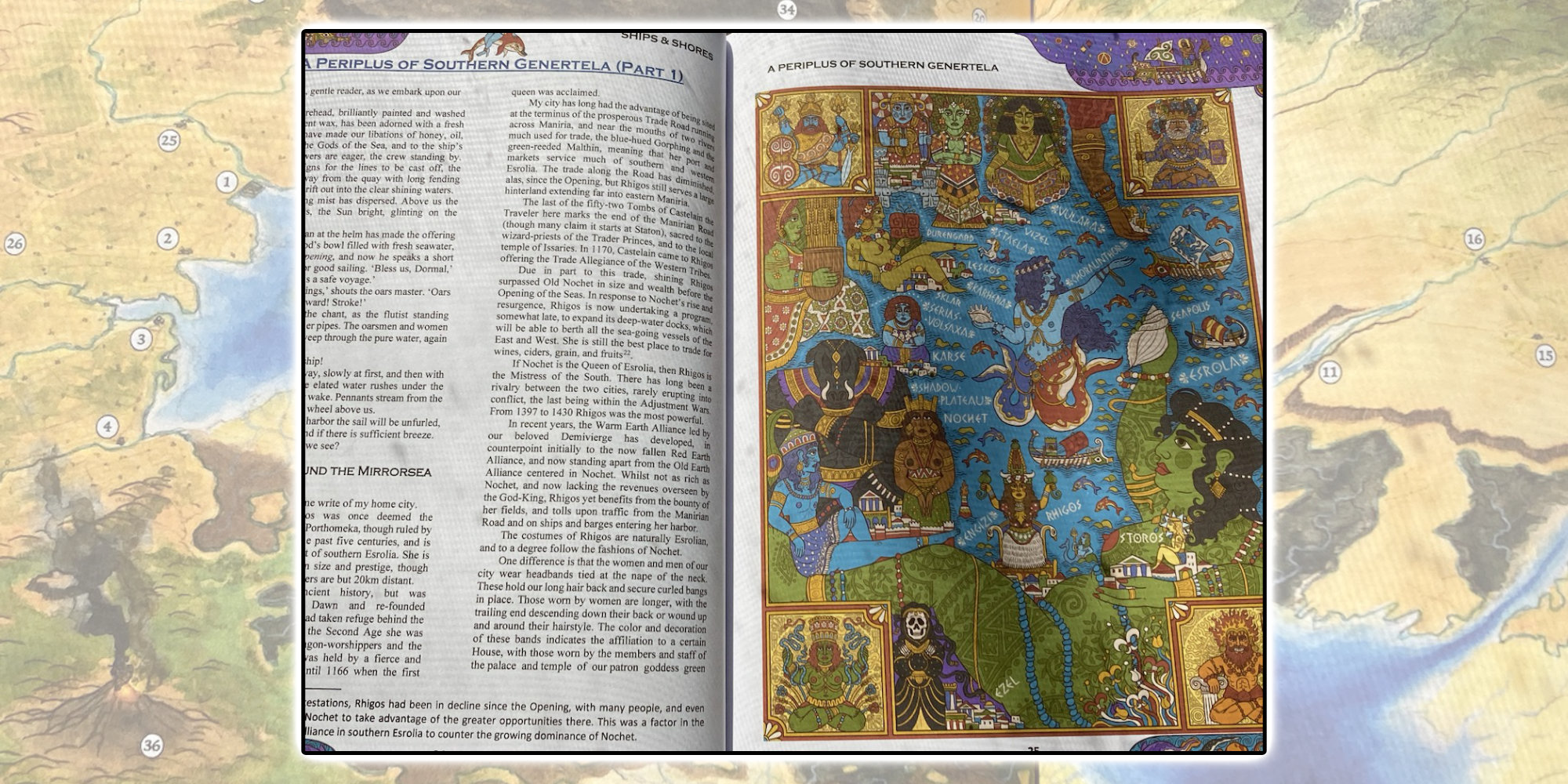
Ships & Shores is fully illustrated in color. The Periplus sections are entirely illustrated by Katrin Dirim in her distinctively “mythic” or “ancient world” style (unless I’ve forgotten an illustration by someone else). As shown above, these images show locations and landscapes as deities tangled together.
Often, an annotation is included which provides additional context or information. This typically describes the deities in the illustration, and mentions that the illustration is from a wall painting in a temple or palace. This contextualizing somewhat reminds me of Pausanias’s description of temples throughout Greece—albeit in this case, we actually have illustrations to accompany Rossvaran’s journey.
Spot illustrations—also by Dirim—throughout the Periplus are frequent. They add additional color to the story, often depicting local versions of gods or goddesses. While not quite as weird as the “manuscript illuminations” Dirim contributed to Chaosium’s Pendragon 6E, they are a charming addition to the Periplus (and I suspect I’m in the minority for wanting more illustrations of rabbit pilgrims).
All of the character portraits between chapters are by Mark Smylie. These portraits are high-quality as well, with good attention to detail. They focus on depicting ordinary moments, rather than action scenes. This theme suits the Periplus well. While it does contain action-movie moments—and they’re quite good—the everyday experience of travel in Glorantha feels like the work’s larger focus.
The text itself has been carefully proofread, but it does need a line edit. This type of edit focuses on a text at the sentence or paragraph level, rather than large-scale story revisions or word-scale typo-hunting. I’ve noticed two main infelicities while reading: overlong sentences, and shifts in tense from past to present. For example,
At the furthest end stood a statue, perhaps also of polished limestone or a cream-colored marble, lightly tinted, of the heroic figure of Kaxtor, larger than life-sized, as a noble beardless youth with his arms hanging by his sides and his legs parted, as though to step forward to greet us, with his hair arranged in braids upon his forehead and hanging to his shoulders in an antique manner. (Ships & Shores, page 184)
The work’s extended comma clauses are clearly part of the author’s style. They do not frequently run to this example’s length. That said, I believe a line edit could strengthen the style without pruning it into a generic, modern, “literary” form.
(Looking at you, Hemingway.)
Naturally, the tense changes are more straightforward. Some sections are written in present tense, and some are written in past tense. However, there is rarely a difference in the passage’s context which necessitates this change. The easiest example of this is in dialogue tags, to observe the difference between “he says” and “he said.”
Conclusion
I’m rather skeptical about the use of in-world fiction for RuneQuest and Glorantha. This goes back to King of Sartar which, bluntly, I think is rubbish. Mysterious allusions in fiction like the Zin Letters or Jalk’s Book don’t work if it’s not eventually revealed that they’re alluding to something. It’s analogous to Chekov’s Gun when foreshadowing; mystic mumbo-jumbo isn’t a good vehicle for stories.
The latter sections of the Periplus drift into this territory. Allusive references to “lost scrolls” about journeys further east, to a journey to Kylerela, to actual events of the Hero Wars, are the type of text which is frequently abused—contrasting with used—in Gloranthan in-world fiction.
However, these “lost scrolls” exist within the context of a fleshed-out and engaging story. They are a successful tease. And, I suspect, they are Helsdon’s way of providing an “ending” to the Periplus while trying to construct Ships & Shores from its various components.
This culminates in a simple fact: “A Periplus of Southern Genertela” is an excellent fiction read, which can also inspire RuneQuest adventures. It brings a great deal of life to the Holy Country, and presents regions outside RuneQuest’s core game area in an engaging and intriguing way. The Periplus section on Melib, for example, is probably more fundamental to my thinking about the island than the Guide to Glorantha (my players haven’t visited yet, but soon shall, so it’s at the fore of my mind).
Do I think the Periplus would be stronger if we had a full narrative, no “lost scrolls?” Yes.
Does that mean the Periplus is bad? Gods, no. Further, it does not feel “incomplete” by their absence. The three main chunks are each a cohesive story which concludes with Rossvaran’s return to Rhigos.
If you’re interested in reading it for yourself, Ships & Shores is available from DriveThruRPG in the following editions:
- PDF: $24.95
- Standard Hardcover: $59.95
- Premium Hardcover: $94.95
While those print prices look outrageous, that’s just the reality of Print On Demand—there’s no crazy markup going on. I have the standard edition, and I think the color looks pretty good. “Premium color” books do have a discernible improvement—and the art in Ships & Shores really is gorgeous—but I don’t know that I’d recommend spending an extra $35 on it.
Next week will finish up the review with a look at the “Ships & Shores” chapters. See you then!
Want to keep up-to-date on what Austin’s working on through Akhelas? Go ahead and sign up to the email list below. You’ll get a notification whenever a new post goes online. Interested in supporting his work? Back his Patreon for early articles, previews, behind-the-scenes data, and more. Or head over to DriveThruRPG to peruse his publications!
You can also find Austin over on Facebook, and increasingly more often on Twitter.
 Akhelas
One thought on “REVIEW: Ships & Shores (Part 1)”