Back in June, Chaosium didn’t just release the Pendragon Core Rulebook—they also released their first hardcover adventure for the game line: The Grey Knight. I’ve already reviewed the prior, so now it’s time to review the latter!
I went into a LOT of detail last time on the Core Rulebook’s layout, physical quality, and so on. I’ll address production quality as usual in this review, but I shan’t be repeating myself—if you’re interested in paper stock and things like that, check out my other review. The description and comments are the same for both.
Disclaimers: This review includes spoilers for this product’s adventures. I received free review copies of the Pendragon Core Rulebook and The Grey Knight in exchange for an honest review. Thank you, Chaosium!
What’s Inside
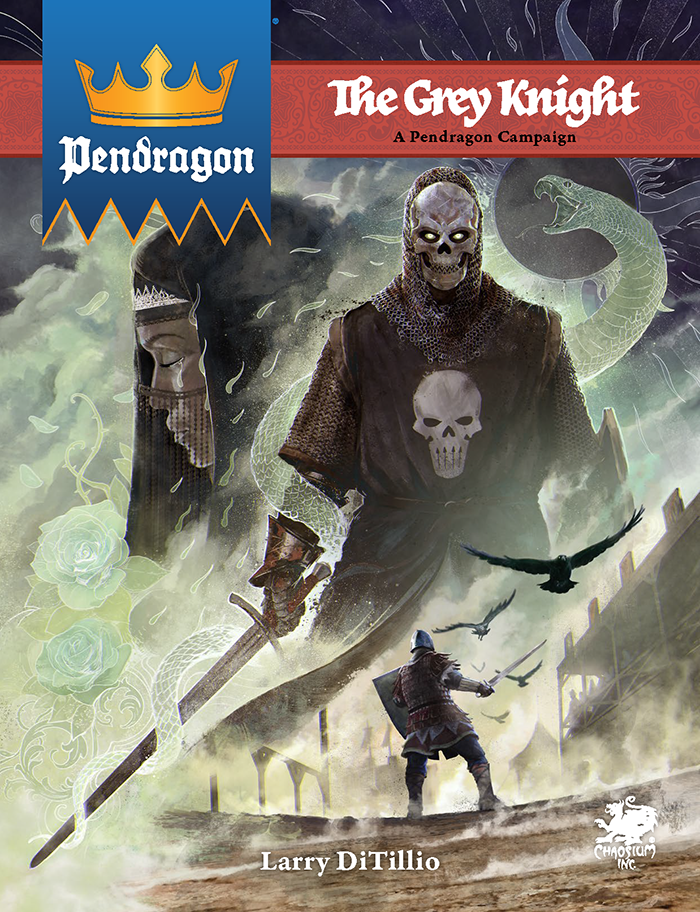
The Grey Knight: A Pendragon Campaign is an 86-page hardcover collection of three adventures: “Bearding the Lion,” “King Pellinore’s Quest,” and “The Grey Knight.” The titular 56-page adventure is an edited reprint of the 1986 adventure of the same name, with the obvious visual remastering. It is written by Larry DiTillio—one of the masterminds behind Call of Cthulhu’s classic campaign Masks of Nyarlathotep—so my expectations as I began reading were, understandably, quite high!
The book is basically organized into the “front stuff” and “The Grey Knight” proper. The other two adventures tell a short story involving two or three scenes of Arthurian drama, typically with a single central fight. For example, “Bearding the Lion” gives the Player-knights the opportunity to capture or kill the villainous King Ryons prior to the Battle of Terrabil. The conflict with Ryons is central, while the Battle of Terrabil is briefly described. Notes are provided for gamemasters who can reference the Pendragon Starter Set for Battle rules, while those with just the Core Rulebook are directed to summarize the conflict.
Rounding out the “front stuff” is a brief description of the city of Carlion. King Arthur’s current seat, Carlion is the site of an Easter tournament at the start of “The Grey Knight.”
“The Grey Knight” itself is a long adventure divided into several sections, each of which seems likely to require at least a full session to play. In contrast I estimate the two other adventures are intended for a single evening’s play, culminating in somewhere around seven to twelve sessions for the whole book. The first two adventures are connected by themes and plot into “The Grey Knight,” and the book states they’re set up to continue campaigns begun with the adventures in the Pendragon Starter Set. For example, the Player-knights actions in “Bearding the Lion” result one way or another in the death of King Ryons. He is then turned into the Grey Knight by his vengeful lover.
A quick synopsis: the Grey Knight appears during an Easter tournament in 517 and challenges the justice of King Arthur’s reign. He demands a trial by combat at Pentecost later in the year. Several knights step forward (possibly including the Player-knights), and Sir Gawaine challenges the Grey Knight first. In order to survive the battle, however, Merlin foresees that one of the Thirteen Treasures of Britain are required. This sends the Player-knights off on a quest to find a magical Whetstone which can kill the Grey Knight and save Sir Gawaine.
During their quest the Player-knights adventure into the Wasteland seeking the Whetstone’s location and are faced with several magical encounters. They then seek the object in the Forest of Arroy, where they meet Sir Bercilek before he’s turned into the famous Green Knight (of Gawaine and the Green Knight) and are guided to a fairy kingdom. Upon saving the fairy queen’s horse, the Player-knights receive the Whetstone and then race back to Carlion in a desperate attempt to save Sir Gawaine.
As this synopsis suggests, “The Grey Knight” is a fairly linear adventure which focuses on specific scenes and the Player-knights’ roles as the agent through which the non-player characters’ plot resolves. In a very real sense if your knight was Sir Gawaine, the actual Player-knights showing up would certainly feel like a deus ex machina to keep you alive.
I make this comparison because since finishing The Grey Knight I’ve been mulling over whether or not I like the story. My gut says “yes,” but it’s taken me some time to figure out why.
“The Grey Knight” doesn’t quibble about who is this story’s protagonists. It asserts that the Player-knights are definitely the protagonists. Thinking about their actions as Sir Gawaine’s deus ex machina reframes the narrative’s importance. The Grey Knight is vanquished not because the Arthurian legend is so special and cool—he’s vanquished because of the Player-knights’ bravery.
Another reason “The Grey Knight” works is that it puts in the legwork to motivate the players. It doesn’t assume the players will be emotionally compelled by Sir Gawaine’s historical importance or the players’ out-of-character connection to Arthurian literature. Rather, the intrigues and conflicts during the Easter tournament repeatedly provide opportunities for Sir Gawaine to befriend the Player-knights. They also provide incentive for the Player-knights to accept his aid and friendship for connections, sway, and camaraderie. These scenes prior to the quest lay a foundation for the story’s emotional core.
Finally, I do quite like the strangeness of many of the adventure’s scenes. The adventure’s linear structure provides minimal agency to the players, but they do have agency within the individual scenes themselves. For example the Wasteland is not presented as a mapped locale to explore. Instead, it’s a narrative scenery as the Player-knights wander from one scene to the next.
For my RuneQuest crowd, the structure actually feels quite similar to a King of Dragon Pass heroquest in which you travel from station to station. “Success” and “failure” in these scenes isn’t exactly about making the “right” choice. There’s one scene where that is the case, but the “right” choice is “continue the quest!” I’m not inclined to frown on that as a pass or fail scene, since there’s no trick or puzzle involved. Otherwise the scenes tend to be about the Player-knight’s experiences, or how they’ll solve a challenge.
These “experiences” scenes drew me into the narrative because they use Pendragon’s Traits and Passions to effectively mimic encounters with strange and magical nonsense in Arthurian literature. I’m most strongly reminded of the Mabinogion—which I actually don’t much care for—due to the intentional lack of explanation in many scenes. The linear structure captures the fairytale sense of “I was walking along and all of a sudden I saw a lion and a serpent battling one another.” While I didn’t care for this in prose, I’m positively inclined toward it in “The Grey Knight” because it shapes a player’s experience. Reading prose I’m not really interested in “well ain’t that weird?” stories. In contrast, inflicting an unexplained experience on a player seems to me the perfect way to capture the sense of living one of these stories. This is a case where the game’s mimesis may tell particular stories more effectively than the source material.
Regarding player agency, however, I do have one disagreement with DiTillo. In this story the Player-knights always return to Carlion during the climactic duel. They’re beset by witches, bandits, terrific storms, and so on, to delay them so that the time is exactly right. Yet, the gamemaster is also encouraged to track the number of days since the Player-knights left Carlion. This—plus the linear structure—gives me the sense that the days passing shouldn’t really matter.
My other disagreement with this aspect of the story is that Player-knight options are described which might reduce the amount of time passed. If the players take risks hoping to return to Carlion more quickly, I’m inclined to reward their success. The notion that they get slowed down so that the climax is always the same scene rubs me wrong. It works if the adventure cares about experiences, not time. But if time is tracked, player choices which impact it ought to matter.
The other aspect of this is that the climax can result in the Player-knights killing the Grey Knight and being punished for that choice. I actually don’t dislike this! The duel with Sir Gawaine is a matter of honor. The point of playing Pendragon is playing out this type of inner conflict. Within the context of “embracing the consequences” which lies at the heart of Pendragon, it’s reasonable for an adventure’s designer to structure it so that success by this method is a failure. It also must not be presented deceitfully by the gamemaster. If the player fully understands that using the Whetstone themselves may have dire consequences, the choice becomes a delicious tension between pragmatism and chivalry.
As I mentioned earlier, the Battle of Terrabil is presented with some reference to Battle rules presented in the Pendragon Starter Set. This book also includes reference to Tournament rules and Feasting rules in the forthcoming Gamemaster’s Handbook. It’s advertised as playable with just the Core Rulebook, and I do broadly agree. However, I found these references to subsystems to which I lack access—especially the Battle rules, since they’re in a different published product—somewhat disheartening. The book is fully playable but I couldn’t help but feel that I was “missing out” with the Battle of Terrabil, the Easter tournament, and the various feasts.
It’s also worth noting that I was deeply underwhelmed by the description of Carlion. The blurb states that The Grey Knight includes “A full chapter detailing the city of Carlion, including a full-page map.” I feel this is somewhat deceitful. The “full chapter” is one page of chapter title and introduction, two pages of text (including fortification statistics which aren’t explained in the Core Rulebook), and the full-page map. This is substantially less than I’d anticipated. For contrast, my expectation was something similar to the description of Jonstown in the RuneQuest Starter Set or Apple Lane in that game’s Gamemaster Screen Pack. The text is also padded by two quotes from Arthurian literature (good quotes, mind; I do love Tennyson’s Idylls).
I don’t mind that Carlion’s information is scant. More would be nice, but I don’t feel more is particularly necessary to run the adventures. What does irk me a bit is that this is touted as a selling point, a reason to purchase the product (even if I didn’t have to pay for mine).
Want to check out one of my own quests? To Hunt a God for RuneQuest: Roleplaying in Glorantha sends the adventurers into a mythic forest. Their quest: track down a half-mad god. Get it on discount due to the Christmas in July sale on DriveThruRPG!
Production
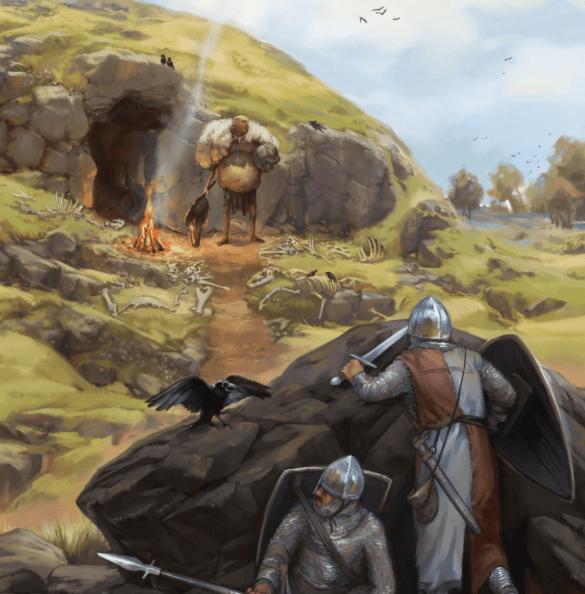
As with the Pendragon Core Rulebook, this book is also beautiful. If you’re reading straight through, give it a little time—the best artwork is in the latter half of “The Grey Knight.”

My initial assessment of the artwork was “decent,” but reaching the latter portion of the adventure made it clear that The Grey Knight admirably fits in with Chaosium’s recent visual excellence. Subjectively, I think there’s fewer of Dirim’s medieval-style figures, but I haven’t been carefully counting to ensure there’s the “correct” ratio or some nonsense like that. They’re still here, they’re still weird, and I still love them.
The textual polish is comparable to the Core Rulebook, or perhaps a dash less tidy. The Grey Knight still hits my subjective “professional standard” for the tabletop industry, and still reflects a welcome improvement over recent releases. Bravo, Chaosium! The ligatures issue I mentioned in the prior review is still present (which doesn’t especially surprise me, since the books were likely produced simultaneously). Since The Grey Knight has fewer sidebars, I found this proofing error less vexing.
As a last note, it’s worth mentioning the Maps. The Grey Knight includes a full-page map of King Arthur’s Britain and three zoomed-in sections which detail the environs of Carlion, the Forest of Arroy, and the Wastelands. The zoomed-in sections are attractive but a bit difficult to connect to other sections. This is in no small part because the map of Britain is quite difficult to read.
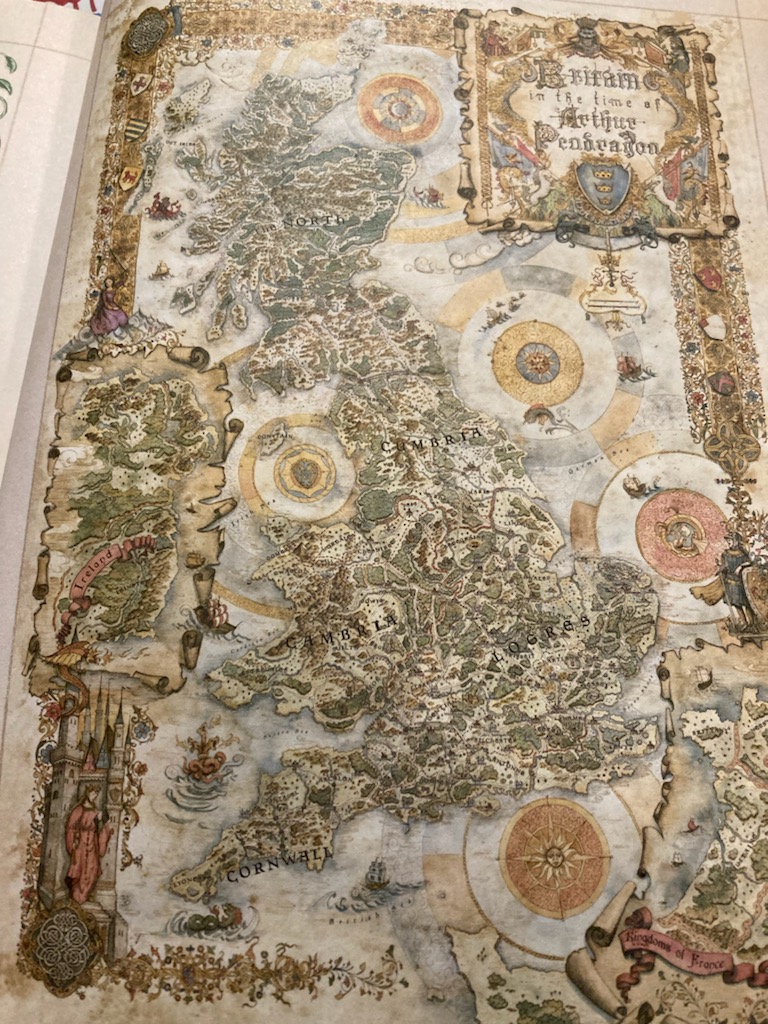
I suspect this map is gorgeous at poster size, but I can’t follow it at all at this size. I’d encourage Chaosium to add this map to the digital version of this product for ease of use. Plus, I bet that will make the zoomed-in maps easier to use.
Conclusion
It’s pretty common that I’ll start writing a review feeling quite positive, and then talk myself into a more critical opinion. The Grey Knight has seen the reverse. When I finished reading this work I wasn’t sure how to feel about it, admiring some elements and down on others. As it stands right now, though, I’m finding that I really like this book.
The Grey Knight definitely isn’t for everyone. Pendragon isn’t for everyone! This grand adventure understands the spirit of Pendragon and presents a challenging, memorable quest for the Player-knights. If you like what Pendragon offers, I’m confident you’ll also like The Grey Knight.
For gamemasters, it is worth noting that “The Grey Knight” strikes me as a difficult adventure. I wouldn’t run this for new Player-knights, and I don’t think it’s intended that way. I’m rather confident that this book is intended to be run directly after the Pendragon Starter Set, after the players have become familiar with Pendragon and their Player-knights have gained some experience on prior adventures. The Player-knights need not be experts, but having achieved the Chivalrous Knight or Religious Knight aspirations described in the Core Rulebook will likely improve player experience.
As an aside, The Grey Knight occasionally references a Pendragon Player’s Handbook instead of a Core Rulebook including in the product blurb on the back. This pretty much explains why the now-Core seems to be missing key sections. It’s a shame that product’s title is inaccurate, because it’s quite good as a Player’s Handbook.
The Grey Knight is available in PDF on DriveThruRPG for $14.99, or in hardcover from Chaosium for $29.99. As usual, purchasing from Chaosium directly always includes the product’s PDF. Plus, their customer service is excellent (and I’ve needed it on occasion).
Are you getting fair content for your cash? I think yes. I feel like at minimum this book will get customers six sessions of Pendragon play, and I think that’s a pretty fair amount of content for the price.
It’s worth noting that the name “campaign” feels like a bit of a misnomer. I think this isn’t intentional. The use seems due to archaisms I’ve noticed here and there throughout the books (like referencing outdated Dungeons & Dragons “magic-users” in the Core introduction instead of wizards). The Grey Knight isn’t a “campaign” in the current sense because it’s basically one long adventure, not a sequence of adventures connected by a single plot like Tales of the Lone-Lands for The One Ring 2E or Curse of Strahd for Dungeons & Dragons 5E.
That caveat aside, The Grey Knight is definitely giving your money’s worth in play time, ease of use, and production quality. I point out the use of “campaign” not because it strikes me as deceptive, but because I can see some customers having different expectations of the book.
Until next week, then!
Want to keep up-to-date on what Austin’s working on through Akhelas? Go ahead and sign up to the email list below. You’ll get a notification whenever a new post goes online. Interested in supporting his work? Back his Patreon for early articles, previews, behind-the-scenes data, and more. Or head over to DriveThruRPG to peruse his publications!
You can also find Austin over on Facebook, and increasingly more often on Twitter.
 Akhelas
Nice review good sir!
LikeLike
Nice review good sir!
LikeLike