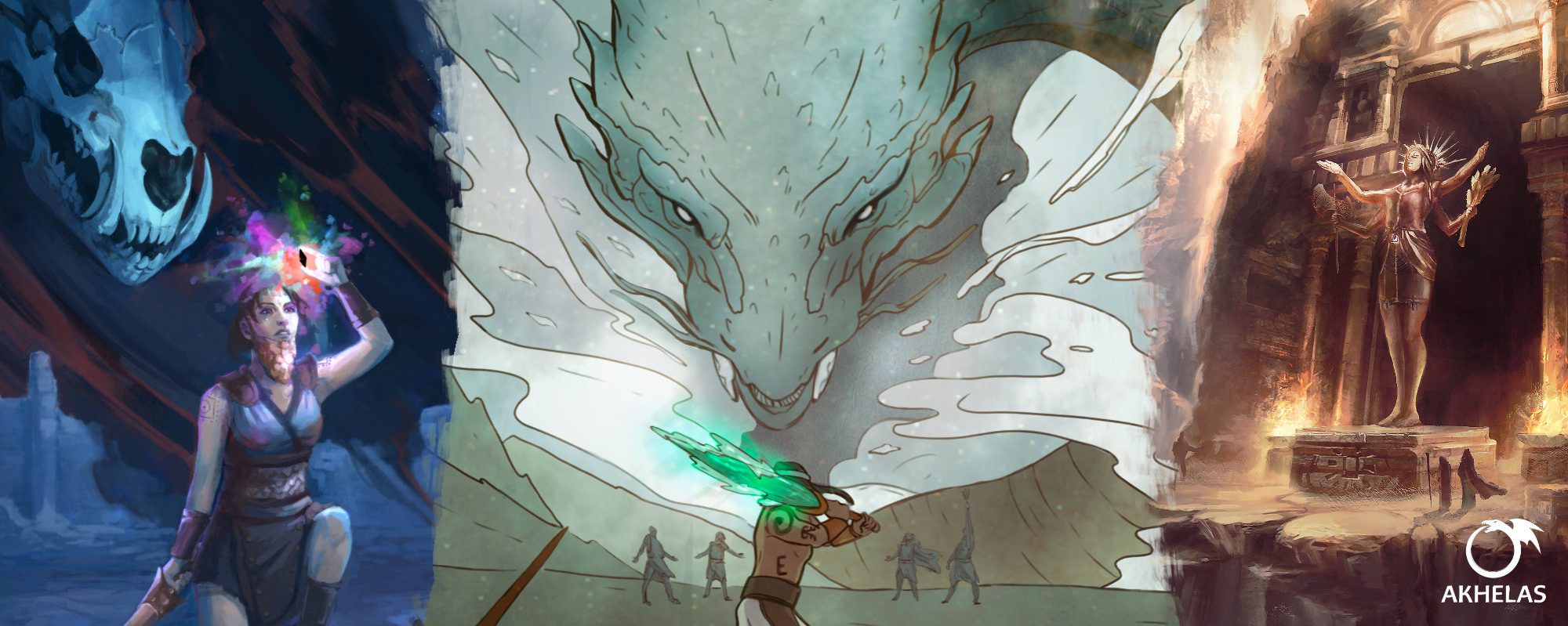
The Trickster is a character found in mythologies all around the world, from Loki of the Scandinavians and Coyote of the Native Americans, to Sun Wukong in China and (I’d be tempted to argue) Judas in Christianity. This transgressive figure is nonetheless necessary for his culture’s worldview to make sense. Judas’s betrayal of Jesus is a foundational sin—but without that betrayal, would there have been a crucifixion?
Currently, my longest-running RuneQuest (RQG) adventurer is named Illostan. And yes, he’s a trickster. I’ve come to really adore this archetype for its blend of helpful and harmful. He’s also a shaman-in-training, and just about to awaken his fetch and become a full shaman. So I’d like to dedicate this week to Illostan by exploring trickster spirits.
The Eurmal cult in the Lightbringers book does a great job exploring the Trickster as he’s known by the Orlanthi. Is that the whole story? I think there’s room, intentionally, for Eurmal and the other cults in this work to expand and grow. There’s a particular line in the RQG core rules which caught my eye when I began playing Illostan back in 2020:
Trickster spirits can be summoned and worshiped by shamans for spirit cults. … Most tribes only know how to summon one or two types of trickster spirit.
—RQG 294
This got me thinking—what does the Trickster look like when he isn’t Eurmal?
Not just when Eurmal’s wearing his Praxian “mask” and calling himself Raven, or whatever the hell he calls himself in Pamaltela. I think the Trickster goes deeper than that. It’s more than “just Eurmals” all the way down. Rather, I see the Trickster as, well, what the book says; a bunch of different cults on which the God Learners slapped the name “Eurmal.” Our subcults in Lightbringers are just those tricksters for which the Orlanthi agree with the God Learners.
Despite not having the same name and mythology as multifaceted Eurmal the Lightbringer, I do think these separate trickster spirits are part of “Eurmal” in a rules-mechanical sense. That’s the essential paradox—they are not Eurmal, but the followers of these spirits can nonetheless swap with one another. This is a contradiction, yes, but it’s a contradiction which is essential to the nature of the gods and spirits involved. We might say that a bunch of Storm Gods are basically “masks” for Orlanth, and be pretty much correct. With Eurmal, there’s no one truth behind the mask.
There’s not much to say here about the rules mechanics of playing an animist trickster which isn’t covered in Chaosium’s books. As an initiate, you get the benefits of each shrine to a trickster spirit which you attend, same as Eurmal. As a shaman, if you want to find a new trickster spirit just go to the Spirit World and use the procedure for founding a new spirit cult.
You might have to abandon your old trickster shrine. But to be fair, that guy was probably a bastard anyway. This new trickster spirit? He’ll never be a bother. Definitely worth the switch.
For tribes knowing how to summon a trickster, I imagine this is secret lore either passed down orally or in scrolls under Lhankor Mhy’s care. It’s sacrilege to destroy knowledge, after all, but just giving it to a trickster? That’s risky. But sometimes you need risky. That’s just why people keep tricksters around. Some years they leave a back door open into the Otherworld and let out dwarven spirits to remodel your city. Other years they get transformed into a cow and have to go seduce Storm Bull minotaurs. (Yes, Illostan is extremely cool and awesome and totally not the father-mother of a bull spirit.)
Why take this time if the basic mechanics of a trickster shaman are pretty much covered by the published material? Well, new spirits are fun. Let’s talk about a few.
Three Trickster Spirits
Each of these spirits is basically the “seed” of a Trickster subcult. None of this is quite fleshed out into a full spirit cult (like the spirit cults found in Treasures of Glorantha 2: Relics of the Second Age, shameless plug!). When imagining trickster spirits I like to start from either a mental image of something “trickstery,” or from a cool idea for a Rune spell. This is like working forward or working backward. Both methods work well, it just depends on how the brain’s working on a given day.
We have Raven in Prax, but to my knowledge there’s no published Fox spirit. As the Fox is a common motif for trickster nonsense, this felt like a natural idea back when I was brainstorming potential spirits Illostan might bump into during the campaign. Better yet, roleplaying a Fox spirit is pretty easy because of how familiar the motif is in stories, cartoons, art, and so on.

Having found a spirit, I wanted a spell which sort of evoked the stealing, sneaky feel of foxes in folktales. I came up with Squeeze, a temporal Movement Rune spell which costs 1 or 2 points and lets the caster fit through any gap they can see through. I was actually thinking of my cat here, and how he’ll squeeze into spaces which astonish me sometimes. In games I imagine this will be stuff like fitting under a door, or through a lock, but I’m sure there’s more devious uses.
The next two began from “Ooh, that’s a cool spell idea.” The spirits themselves are a bit unclear—more like a bundle of images or ideas than a finished concept.
First, we’ve got the spell Look at Me. The core idea came from my friend Peter Thomé. Basically, it’s a 1-point instant Disorder Rune spell which makes everyone in range look at the caster. Those people get the equivalent of a critical Scan success, too. Plus, any magical alarms, defenses, detections, and so on within range also trigger. I love this idea because it plays into the notion that a trickster is a scapegoat. In this case, they’re the decoy rather than the person trying to get away with hijinx. Probably?
This spell’s associated with a Sky trickster spirit, probably either a bird with really flamboyant feathers, or a bright and shiny light. Or perhaps a torch. The spirit always wants attention, and doesn’t care whether that attention is good or bad.
The second spell, I’ll admit, I got from Bugs Bunny. Stop Hitting Yourself is a spell which activates the next time the caster is damaged by a creature with INT. Instead of hitting you, the damage hits the person who struck you, using the same D20 result for hit location. I see this spell probably as a 1-point temporal spell, which goes out of effect once it’s been triggered. You can probably stack points in it for extra uses.
Another mechanically interesting idea is modeling Stop Hitting Yourself as a one-use spell with no duration. Instead, the spell just triggers whenever you happen to get injured, and then is gone. If you’re careful about avoiding combat, you could stack up quite a few instances of Stop Hitting Yourself over time. I might increase the damage dealt if it’s a one-use spell—not sure.
Why doesn’t the spell work on creatures without INT? Well, the way Bugs Bunny toys with his cartoon opponents usually involves outwitting them via cartoon illogic. That seems like it’d work on a person, but won’t work on a bear or a tyrannosaurus or something like that. (Unless, of course, they’re a sentient one!)
However, the Bugs Bunny comparison falls apart when we think about the associated spirit. It just doesn’t feel right that a rabbit spirit would be doing this. Instead, I think we’ve got a spirit associated with both Illusion and Disorder, quite possibly a clown. Hell, this could actually just be another Eurmal subcult—or it might not be, but could become one during a campaign, as the player convinces the Orlanthi that their spirit indeed is just another version of Eurmal.
Naturally, persuading them to believe this is, itself, merely another joke. Only the Trickster knows the Truth.
Want to keep up-to-date on what Austin’s working on through Akhelas? Go ahead and sign up to the email list below. You’ll get a notification whenever a new post goes online. Interested in supporting his work? Back his Patreon for early articles, previews, behind-the-scenes data, and more.
You can also find Austin over on Facebook, and a bit more rarely on Twitter.
 Akhelas