The last few times I’ve written here about the Endless Lands setting focused on cosmology or magic. Today we’ll give an overview of the cultures and regions of Akhelas. I’ve realized I don’t have a clearly presented description of the world or definition of my various Weird Fantasy Names that I can point at and reference easily. So, this article shall fill that void!
Keep in mind that this continues to grow and shift in my head each time I play with the setting. Nothing here is set in stone. That said, most of it has not substantially changed in years and I have no reason to believe it shall.
The Lands
The primary region of the Endless Lands I’m concerned with is called Akhelas. Etymologically, this roughly means Land of the First City. A second large landmass called Havveras exists a few hundred miles away over the ocean—within sailing distance, but the trip sucks—and shares a connected magical ecology.
Both of these landmasses are analogous to a continent on Earth, although probably closer in size to Australia or Europe than to Africa or one of the American continents.
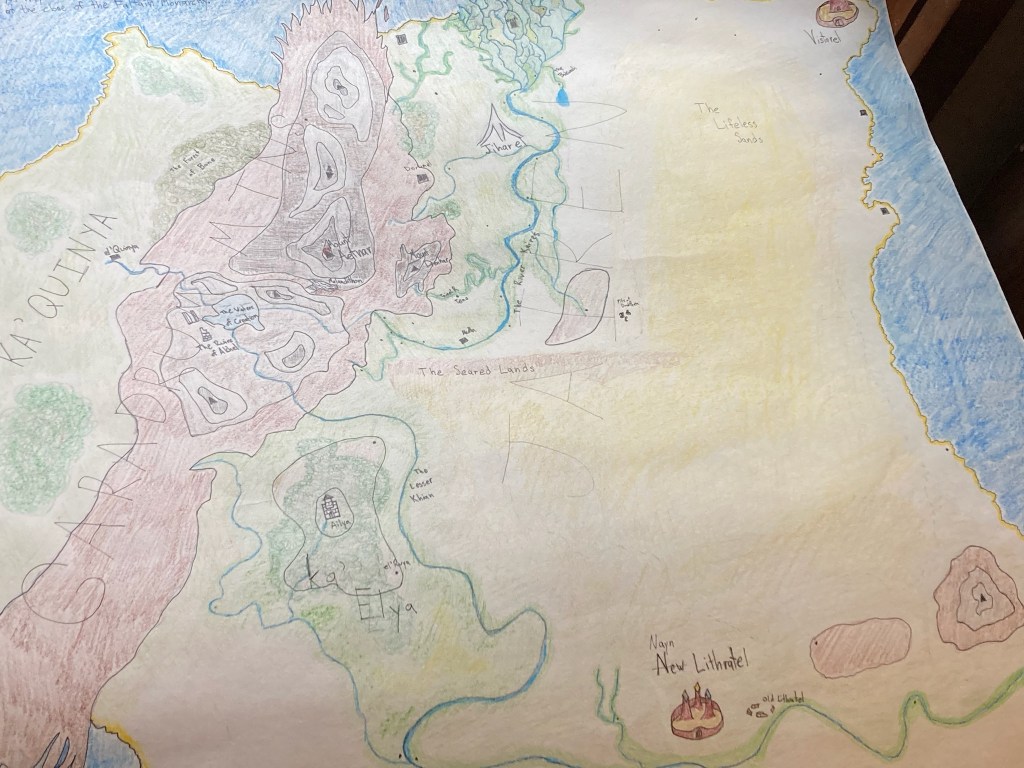
Geography of Akhelas
Akhelas is geographically organized into two loose regions: Jairen in the north, and Nothen in the south.
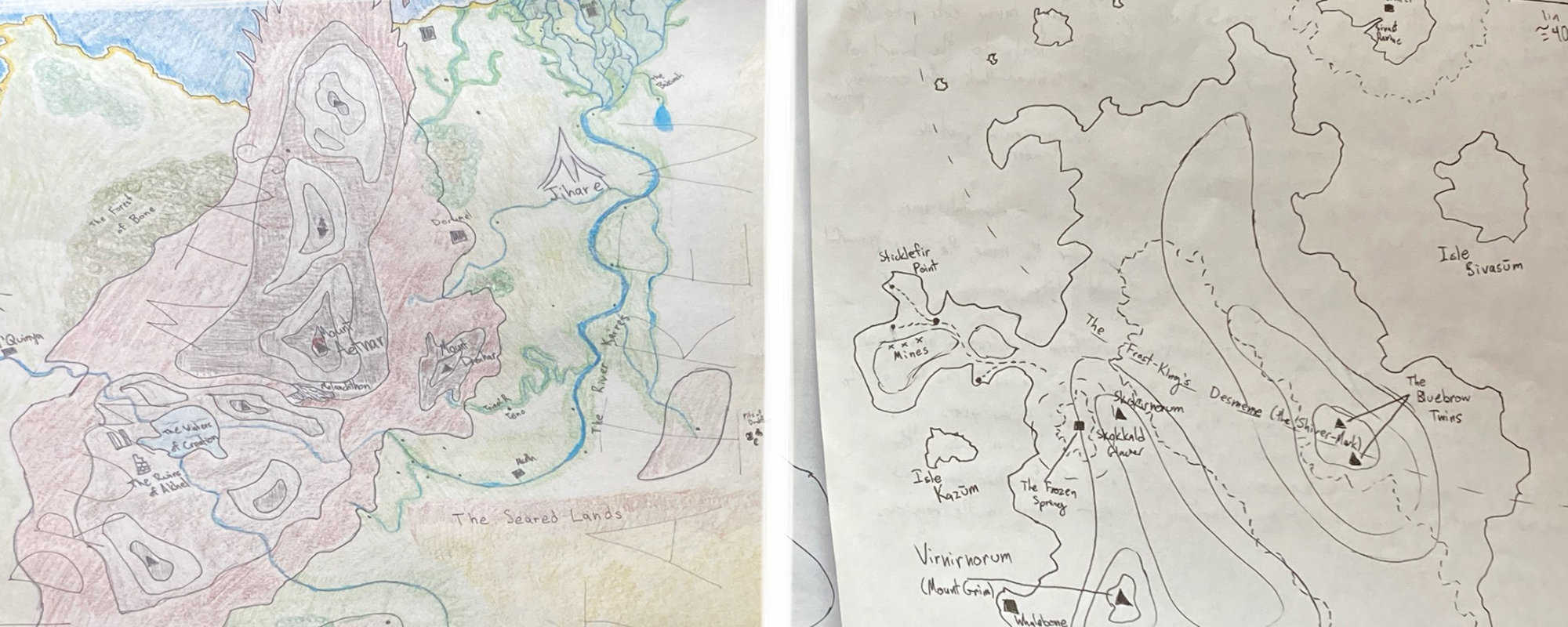
As that map likely suggests, Jairen in particular is the focus of my attention. The northern half of Akhelas is dominated by a central wasteland or desert, a scar left behind after the cataclysmic Lightswar around 1,000 years before most fiction written in the setting.
The Kaires River flowing north waters the primary fertile region, together with various streams, tributaries, and meltwaters from Garath’s Mountains. My Earth analogues are Mesopotamia or the Nile River valley, although rainfall is more consistent than in either.
Across the mountains from Jairen is the isolated region of Quinya. It was not dragged into the Lightswar, and contains a patchwork of multiple types of forest. The most famous is the leafless white trees in the Forest of Bone.The region of Elya, in Jairen, is populated by descendants from a shared ancestor with the Quinyans.
The boundary between Jairen and Nothen is the east-flowing Khian River. A new desert north of it, the Scar, was created by a Jihari warlord in a feat of magic which destroyed an invading Nothi army (and much of his own). Prior to the Scar’s formation, travel between Jairen and Nothen was easier.
To the south, Nothen is a region slightly larger (probably ×1.5) than Jairen, and substantially more fertile. The spiritual ecology is more hostile to Half-Made (humans) than in the north, resulting in a fractured and diverse landscape. I’ve never mapped Nothen, but it’s characterized by temperate climates, sparse forests, and rugged mountains. Earthly analogues are similar to Appalachia or the river valleys of China.
Geography of Jairen
In the mind of its people, Jairen is dominated by the Kaires River. The Khian River and Elya are not trivial regions, but they also aren’t the “true heartland” of the Jairi.
Jairen is organized into the Nine Cantons, blurry cultural and geographical areas traditionally associated with a major city and one of the Nine creator-dragons. Sometimes, a Canton is defined by a clear geographical boundary. At other times, a Canton’s definition is a barely-discernible shift in culture (such as between Orsen and Jiharen). The exact nine aren’t currently well-defined, but I use the concept on occasion.
The Kaires River reaches the ocean in a large, marshy delta. Its headwaters are in an isolated valley of Garath’s Mountains, not far north of the Scar. Its western bank remains more fertile than the east, due to the central wastes. Past the agricultural region, rolling hills rise higher into a dense, forbidding forest known simply as the Darkwood.
The eastern side of the river valley is indeed arable, and it is some distance before the wastes begin. The most important landmark on the eastern side of the Kaires is the Pit of Drakthein, an enormous sinkhole around which the Cult of the Ninth keeps a priestly school. They claim the Last Dragon himself still exists at the pit’s bottom.
Elya is nestled in the land between the Khian River and one of its major tributaries, a sibling of the Kaires. It is dominated by a deciduous forest, with the Canton’s city isolated at the center.
The Khian River still flows strongly, but ever since the Scar was formed the land along both of its banks has been less fertile, but especially on the northern side. Smaller than the Kaires, with fewer tributaries, the Khian is more easily crossed. Frequent raids, battles, and other “adventures” contribute to the land’s malcontent.
In the northeastern corner of Akhelas is Vistaren, a Canton whose people stubbornly refused to yield when the central wastes first expanded. The land is barely arable, but manages to endure nonetheless. The city of Vistarel is the main setting-off point for sailing to Havveras.
Geography of Havveras
Havveras has also experienced a magical disaster, but of a different kind. The Lightswar was caused by the Half-Made, in their passions and to their sorrow, whereas on Havveras one of the great spirits has risen to power so terrible he cannot be stopped. This Frost-King has covered much of the land in a glacier and permanent winter (and even outside winter, the land is difficult to live in). My Earthly analogues are Siberia and the forested regions of northern Canada.
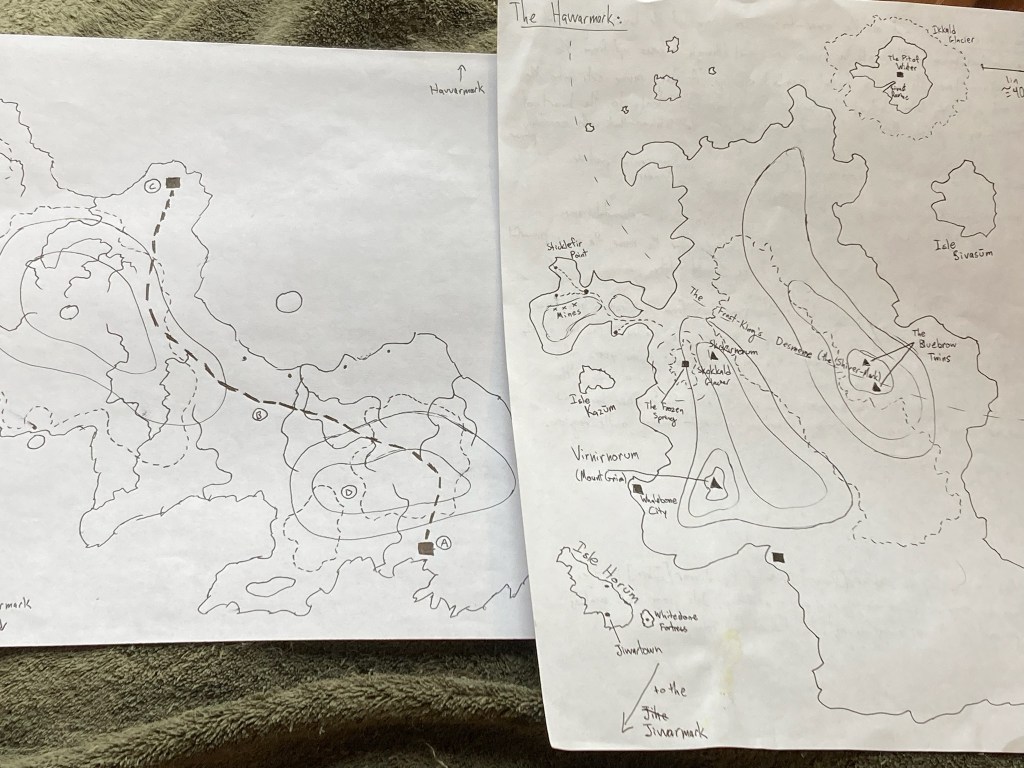
Despite having interesting maps, I know little of this place. In particular, Isle Horum is where the Jairi primarily visit (Jivvartown). Horum has fairly temperate summers, but bitter winters. It’s known for the pods of “tuskers” which migrate through the area after each winter, which are similar to Earth’s seals or walruses, but with forward-pointing tusks in place of anterior limbs.
Interested in exploring some published work by yours truly? To Hunt a God for RuneQuest sends adventurers into a mythic forest on a desperate heroquest to perform divine euthanasia. Acclaimed as “one of the absolute best products available for the Jonstown Compendium,” picking up a copy is a great way to support me making more weird fantasy stuff!
Three Cultures of Jairen
Each region on Akhelas is populated by an eponymous macroculture (the Jairi and the Nothi), which are probably more analogous to an “ethnicity” than a national or cultural “identity.” My attention rests more heavily on specific cultures among the Jairi, as I’ve spent much more time dreaming of Jairen than of Nothen.
Added to this is the Quinyan macroculture to the west. All three groups come from the same population of Half-Made in the distant past. The Jairi and Nothi are more closely related, because they descend from a shared Akheli culture which accepted the Seventh Dragon’s invitation to move to Akhel. The Quinyans (and therefore also the Elyans) are descended from those who remained behind.
The Akheli split during the Lightswar, loosely described as “the followers of Jair” and “the followers of Noth.” Obviously, this is an enormous over-simplification. The two macrocultures nonetheless do have a long history of interaction, both hostile and peaceful. One story they agree upon is that no one won the Lightswar—it was a disaster for all sides which birthed the Ninth into the cosmos. However, blame for starting the Lightswar remains a bitter debate.
As noted above about Cantons, each culture of the Jairi is traditionally associated with one city, one geographical area, and one of the creator-dragons. Some of these associations are locked-in, but most are not, so I’ll avoid referencing them as a general rule.
The Jihari
The Jihari are the focal point of my creative work. They are the Star-folk, or perhaps more precisely the Children of the Silver. Their home, Jiharel, is the oldest city with continuous habitation, and their Canton defines much of the Kaires River’s rich agricultural land. The Jihari traditionally dominate the Council of Lords, and their High Lord also inherits the title Monarch of Jairen. The extent to which they can actually exercise such alleged authority, naturally, varies from generation to generation.
The Jihari culture is my “baseline” for the Jairi in large part because Jiharel survived the Lightswar. Other cities were either destroyed and refounded, or were founded in the subsequent centuries. They aren’t the oldest branch of the Jairi, but they are the oldest branch which survived.
Jiharel’s palace is a divinely-created artifact of another era, primarily built from glass or crystal, a gift from the Second Dragon. The Jihari’s relationship with the Second Dragon descends from the Silver People, one of the populations in the Aether. According to legend, the Silver Stars interbred with a band of Jair’s followers. Because of her maternal love for the Silver Stars, Second Dragon loved the Jihari best among the Half-Made.
The core of Jairi culture is a mythological or religious text called The Songs of the Nine. The Jihari believe it was composed by the Akheli, and that they’ve merely transmitted it down the generations. Slight variants of the Songs exist in each Jairi culture—and the Nothi agree with the basic claims, though they haven’t inherited that specific version—but these variants are probably based on an early version which spread during the first century AL.
Organized around the Nine creator-dragons, each cycle of the Songs tells how one aspect of the cosmos was created. It touches on the Lightswar because of the Ninth’s deeds and because of the death of dragons, but does not contain “the story of the Lightswar” in the same sense that the Iliad contains “the story of the Trojan War.”
While originally transmitted orally, there is no prohibition against writing the Songs. Literacy is moderately high among the Jihari, but “moderately high” certainly means less than 50% (probably less than 30%).
Socially, the Jihari have a strongly meritocratic bent, although their communal instincts are complicated by admiration of skilled (and/or powerful) individuals. The Jairi social system is more accurately the Jihari social system, exported as the only surviving mode of governance following the Lightswar.
Jihari society governs itself through three tiers of “Lord” (engath in Jihari; a neuter or, more precisely, a “child-gender” noun). The First Lord governs the whole Canton, Second Lords lead a region (typically from a town), and Third Lords lead a single community. Each Lord is selected by their peers, with Third Lords being selected by the community consensus. Lordship is functionally hereditary, with the heir believed most competent typically being chosen to serve in leadership. This likewise typically leads to a system of primogeniture, as the first heir is usually trained and educated for the leadership position.
In addition to the obvious leadership duties of being charismatic, speaking to outsiders, negotiating disputes, administration, etc. the Lords also tend to the community’s bond with the local spirit(s) of the Land. Communities often prefer inheritance when selecting their new Lord for this reason. Given the near-immortality of the Land’s more powerful entities, spirits are more likely to recognize someone’s family (and blood) than to perceive them truly as an individual. This failure of perception goes both ways: “Is not a mountain made out of stones? Is not a city made out of lives?” (Songs of the Nine 7.2.3). But it’s still better for a new Lord to re-forge this connection than for the community to suffer incompetence or try to place a child in charge.
Any engath can be recalled by their subjects through an appeal to the Land. This is straightforward, for the Land’s spirits are aware of a population’s discontent. If the community’s spirit(s) withdraw from the Lord, this isn’t a mere magical problem—their mandate has been revoked, the people’s consent to be ruled withdrawn. Among the Jihari leadership transitions are extremely stable, although this is not the rule for all the Jairi (and the Hegemon’s usurpation of Jiharel is a significant and dangerous exception).
This creates a structure in which individual merit is praised, and competence is often rewarded with power. The fundamental problem of Jihari society is handling iconoclasts, people who acquire power (typically through personal magical practices) without the community’s support or blessing. The Lords wield mighty magic, but this is more often due to inherited spiritual relationships rather than their personal skill. An iconoclast’s presence can disrupt the Lord’s—and thus their community’s—relationship with the landscape. Continuing from Seventh Dragon’s argument above, if a Lord is perceived like a mountain built from stones, an iconoclast is simply the mountain itself. Transferring a relationship is not an instant or trivial task for a spirit, but the fact that an iconoclast can interact with it directly is ecologically dangerous for farming communities of the Half-Made.
Jihari culture does not have a “good” answer to this. The culturally normal behavior is to self-exile or else be forcibly exiled before you’re too powerful to cause trouble. Constant travel mitigates the danger iconoclasts present, due to how slowly most spirits respond to human-paced changes in the world. Likewise, living off alone in the wilderness is generally acceptable because very, very few individuals have ever acquired enough power to, like gravity, bend and warp the Land’s psyche so that spirits are drawn toward them from afar.
Immediate neighbors of the Jihari are the Orsi of the marshes to the north, and the Dorumi in the hills and highlands of Garath’s Mountains.
The Vistari
Living separate from the cultural heartland around the Kaires River, the Vistari in some sense define themselves by contrasts to the Jihari. They’re associated with the golden rivers of fire which illumine Akhelas, the living breath of the First Dragon. Vistarel was settled by the first group of Jair’s followers to descend permanently from the mountains, from love of the sea and despair of walking back home to Akhel. That city was destroyed during the Lightswar, and resettled during the decades in which the wasteland was still expanding.
The Vistari are suspicious of the Jihari, mistrusting the latter’s traditional claim on the Monarch title. They wholly disregard the Orsi, and much trade and traffic between the two cultures is carried out by marshlander intermediaries. The Vistari see themselves as “First of the Jairi” and only grudgingly—if at all—acknowledge the Jihari’s claim to primacy.
In a similar vein, they’re religious weirdos in having the closest culture to monotheism among the Jairi, Nothi, and Quinyans. The Vistari elevate First Dragon above the rest as the single “creator-dragon,” acknowledging the others instead as powerful spirits on the range of Mount Garath, Mount Aitnor, or the Frost-King of Havveras. They venerate the Eight, denying the Ninth’s divinity outright. Further, a schismatic minority also use the Songs to claim Second Dragon is of Voidish origin (1.6.2–2.2.1).
The Vistari have a stronger sense of community, and actively mistrust individuals who develop personal power (such as magicians or heroes), rather than admiring them like the Jihari. This trait existed since the refounding of Vistarel, but has grown much more virulent since the rise and fall of the Hegemon. The Vistari are probably the only culture in Jairen which consistently treats iconoclasts like criminals, requiring judgment and exile and/or execution.
The First Lord of the Vistari has remained of the same family since the refounding, and consequently has a very strong bond with the local land. Several “dynasties” nonetheless developed over this time, shifting back and forth between branches of the “same” family. These branches are now imperceptible to normal ways of thinking about lineage. The Land perceives all of that family’s branches as a single “person” since traditional rites and rituals help members of that bloodline to continue self-identifying as belonging to that ancient clan.
The Vistari are generally condescending to other non-Jihari cultures, but not actively rude, hostile, or unpleasant—like a well-meaning relative giving sweets to an adolescent. Despite having the best-placed port, they have little to do with travel abroad. Instead, the Vistari seem to prefer acting as the middle-man between the Kaires River valley, the southern city-states of Nothen, and the distant frostlands of Havveras. And of course, they get their cut of all that trade.
The Vistari have no close neighbors, unless you count the central wastelands, and the horrors whispered to reside in its center.
The Lithrati
The third of my fairly-well-defined Jairi cultures is the Lithrati. They live south of the Scar, along the banks of the Khian River, mostly clustered around the city of Nayn Lithratel.
The original city of Lithratel was destroyed by a Nothi army circa 1150 AL, and its ruins can be seen from atop the new city’s highest tower. Lithratel’s destruction was followed with a large-scale Nothi invasion for the first time in centuries. The Hegemon led the Jihari, Orsi, and Dorumi to resist, and earned his everlasting fame by unleashing the spirit of Mount Aitnor on the combined northern and southern armies. The devastation’s power is still seen by traveling caravans which use the hardened volcanic floes as navigation landmarks.
About a generation later, the Hegemon built a new city in a more defensible position along the Khian, suitably called Nayn Lithratel. He gave it as a gift to the Lithrati survivors, and a hundred years later they’re still the only culture which remembers the Hegemon with any kindness.
The Lithrati are best known for being outward-looking, interested in the world beyond their walls. This includes both Jairen and Nothen, somewhat surprisingly since their first city was torn down by the southerners. The Lithrati war, trade, and romance the borderlands Nothi seemingly on a year-by-year whim. If there is enduring cultural trauma, it’s not obvious from immediate behavior.
Their social system is pretty much identical to that of the Jihari. As a city on the crossroads, the Lithrati value social (especially mercantile) skills more highly than other cultures, but their system of Lordship remains largely unchanged.
The Lithrati have a complicated relationship with the other Jairi due to their relative isolation. This often boils down to an attitude of “what have you done for me lately?” Their closest neighbor is the Elyans, who rarely have cause to travel downriver. In many ways their true closest neighbor is the borderland Nothi, and there’s probably a substantial immigrant population (10% or so?) resident in Nayn Lithratel.
Want to keep up-to-date on what Austin’s working on through Akhelas? Go ahead and sign up to the email list below. You’ll get a notification whenever a new post goes online. Interested in supporting his work? Back his Patreon for early articles, previews, behind-the-scenes data, and more. Or head over to DriveThruRPG to peruse his publications!
You can also find Austin over on Facebook, and increasingly more often on Twitter.
 Akhelas
One thought on “Culture & Geography on Akhelas”