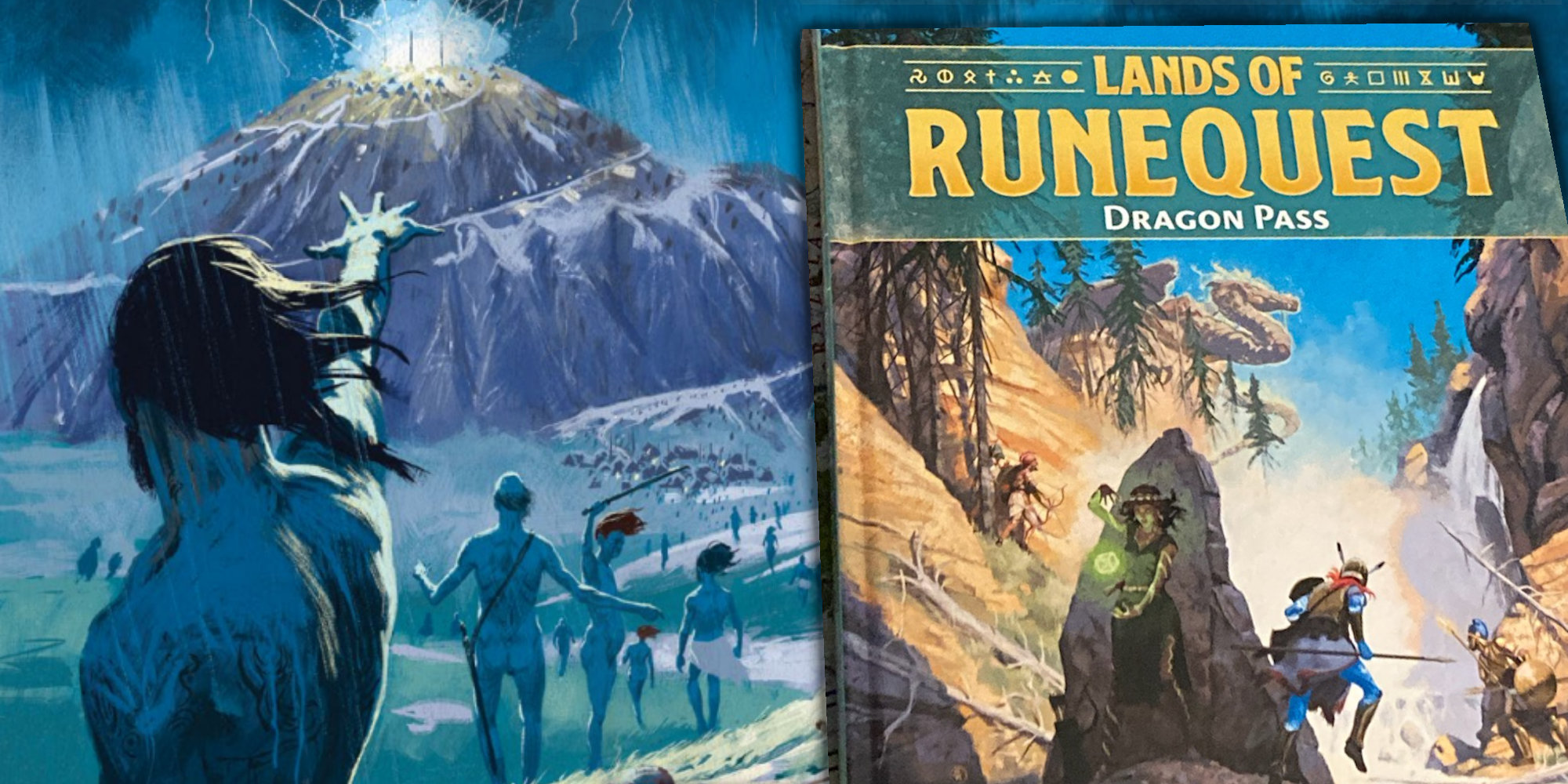
Ever wonder how Sartarite adventurers might, say, travel to Lunar Tarsh for trade (or raiding!) and what they encounter along the way? Chaosium’s latest RuneQuest: Roleplaying in Glorantha (RQG) release comprehensively describes the setting’s core region in Dragon Pass. The first installment in a new sub-line, Lands of RuneQuest, this series focuses on the physical landscape of Glorantha in contrast with the religious or cultural focus of Chaosium’s first sub-line, Cults of RuneQuest.
Yet Dragon Pass has received a lot of attention in the past! From system-neutral The Guide to Glorantha, to the now-unavailable Sartar: Kingdom of Heroes (2012) and Dragon Pass: Land of Thunder (2003) for various editions of HeroQuest, to the founding board game White Bear and Red Moon (1975), and even the cult-classic videogame King of Dragon Pass (1999), this region has been subject to decades of invention and adventure. Is another presentation needed? What can Dragon Pass add which hasn’t been previously portrayed?
Let’s dig in and find out.
Disclaimer: I received a free review copy of this book from Chaosium in exchange for an honest review. Thank you! I also am someone who writes indie RuneQuest stuff, so I do have some financial benefit from the game line as a whole doing well.
What’s Inside Dragon Pass?
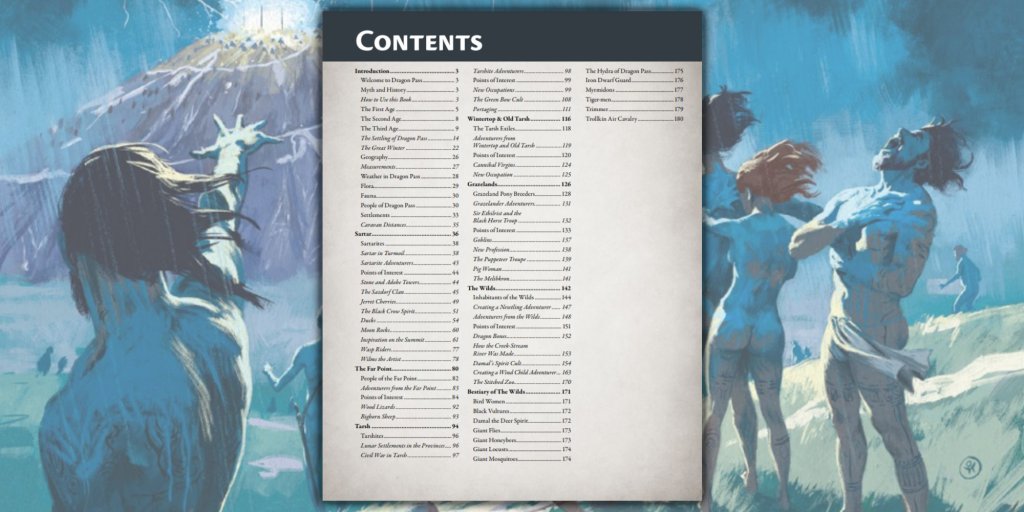
Dragon Pass is a 180-page fully illustrated hardcover which also includes a fold-out poster map of the Dragon Pass region. This region is defined a bit more narrowly than in the core rules, focusing on the Homelands of Sartar, Lunar Tarsh, Old Tarsh, and the Grazelands. The Far Point between Tarsh and Sartar is organized as a distinct Homeland (rather than lumping into Sartar), and the Wilds which surround these areas are also described.
Introductory Overview
The book begins with a general anthropological and environmental survey of Dragon Pass, describing the region’s history, geology, weather, flora, fauna, and so on. If the Guide is a view “from 10,000 feet,” then this is a view “from 1,000 feet.” Still an overview, but one describing specific details about a general area. Despite treading familiar territory, this introduction consciously avoids re-using text or information from other RQG books. For example, Dragon Pass’s description of “I Fought, We Won” describes a specific battle which took place at Snakepipe Hollow, rather than Mythology’s cosmic “simultaneous universal battle” approach. (Although Dragon Pass doesn’t mention Heort at all in this section, which somewhat puzzled me.) As another example, the “Weather” section provides temperature data for Swenstown and Wilmskirk instead of reproducing the Clearwine table as an example for Sartar’s weather.
This same section also begins the book’s fixation on demographic detail about different Homelands and settlements, and provides comprehensive information about distances and travel times on the various roads. As a gamemaster who has tried to calculate this from the Argan Argar Atlas or the large map in the RuneQuest core rules, these charts are extremely welcome. They illustrate how easy it is for adventurers to travel throughout the region, and also mean I don’t have to do boring travel math anymore. Fantastic inclusion.
Overall, this introduction is the second-largest chapter of the book—only the Sartar chapter is longer, unsurprisingly—and it’s a solid use of the pages. Some information is familiar, some is familiar (but intentionally presented from a different perspective), and some is new. In particular, though, the juxtaposition of the different topics develops a strong sense of immersion into a really “physical” world. This only takes a few pages, but sets up the rest of Dragon Pass very nicely.
Geographical Gazetteer
The bulk of Dragon Pass is dedicated to a thorough geographical description of the region by Homeland. In particular, the gazetteer attempts to describe every city, noteworthy town, and fortress on the poster map. A number of settlements are not named on the poster map (particularly in Tarsh). I’m inclined to believe this is not an oversight, but instead intentionally allows for varying Gloranthas. Those described are typically tribal or clan centers, on major trade routes, or have something interesting of note.
“Comprehensive” permeates the entire work, providing a sense that Dragon Pass is a densely textured and detailed part of the fictional world. The Glorantha presented here strikes me as somewhat more “believable” than other iterations I’ve encountered. In particular, the prevalence of demographic information cultivates a strong sense of realism—the suggestion that “we understand the consequences of the worldbuilding decisions, and how those decisions interact with one another.” Combined with the cult distribution charts in Mythology, it’s easy to see how the gamemaster could break down most settlements into their particular religious make-up (while making educated exceptions based on notable features, like the guilds of Wilmskirk).
Another strong feature of the gazetteer is the maps of various settlements. These settlements are largely restricted to Sartar and the Far Point (although Furthest and Bagnot are notable exceptions). Street plans are useful to the gamemaster for creating concrete “you can adventure here, along this street” experiences. A map of Dunstop (Fazzurite stronghold in the Tarsh Civil War) or above-ground Muse Roost (home of the mercenary demigod Sir Ethelrist) would have supported further adventures outside Sartar.
Throughout, the descriptive geographical approach in Dragon Pass portrays Glorantha as a physically “real” place. One weakness of this approach is that many entries lack a narrative component. This is more common with small settlements than with towns or cities. Almost every settlement is described in terms of population, local economy, and religious structures. This is useful information! In particular, information about shrines and temples directly impacts an adventurer’s ability to replenish Rune points while also implying that community’s priorities.
Goodfarm (Village)
Dragon Pass, page 58
This is the main settlement of the Druyeving Clan of the Torkani Tribe. A major temple to Ernalda stands nearby, with a minor temple to Argan Argar and a shrine to Eiritha.
However, the settlements often lack a description of problems. These need not be substantial, but a paragraph about local spirits causing havoc or a greedy chieftain raising tolls would add additional texture to the world. This also applies to the “People Everyone Knows” at the beginning of each chapter—what are their current schemes, their active goals? For example, who is Annstad the Lover aiming to seduce next?
As it stands, Dragon Pass struck me as extremely useful, but not terribly inspiring.
Bestiary and More
In addition to a gazetteer, Dragon Pass includes a 10-page “Bestiary of the Wilds” in the Wilds Homeland chapter. Additional statblocks are peppered throughout the book, largely focusing on describing typical non-player characters (such as a “Typical Sun Dome Templar”).
While I can see the organization being a little awkward at the table—needing to rummage through Dragon Pass to grab a statblock—this is an excellent supplement to the Glorantha Bestiary’s description of Elder Races, Chaotic horrors, and other antagonists. I don’t really see a better way of providing this type of non-player character without re-doing the Glorantha Bestiary and, let’s be honest—we all want Chaosium to focus on the bigger stuff!
As with elsewhere, Dragon Pass mostly avoids reproducing material available in other books. For example, the Wilds includes sidebars providing guidance for newtling and Wind Children adventurers, but directs the player to the Glorantha Bestiary for stats and more detailed information.
More intriguingly, Dragon Pass has described a very interesting new Terror: The Hydra.
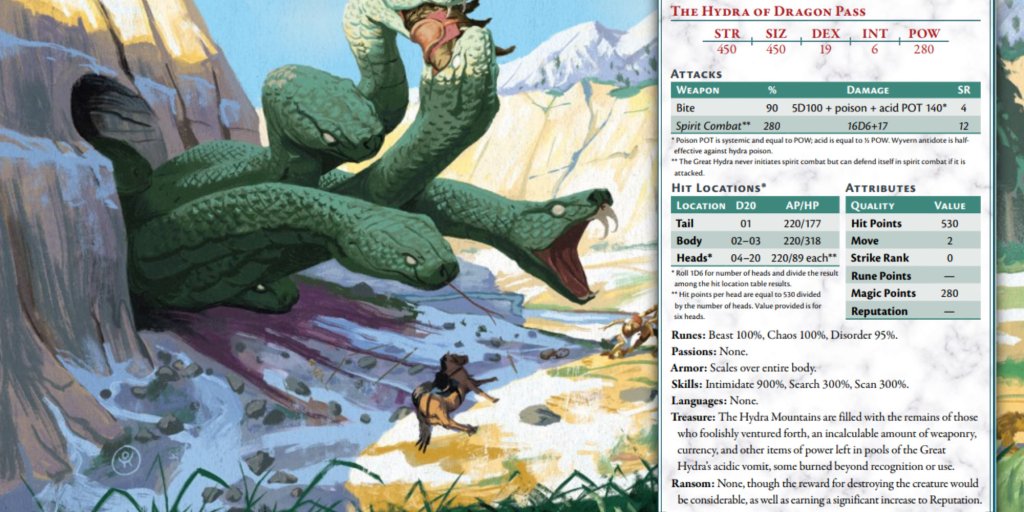
Not sure the artist—by comparison to the cover, maybe Ossi Hiekkala? Illustration © Chaosium, Inc.
So, uh… yeah. That’s an enormous monster. I’m actually surprised it’s given a mechanical description—it feels somewhat against the aesthetic of RQG as stepping away from the “Super-RuneQuest” model of skills with hundreds of percentiles found on and off during the 80s and 90s (for example, Dorastor [1993]). My instinct says “Sandy Petersen!”
The inclusion of new non-player characters and critters strongly supports the book’s blurb goal of “running a sandbox-style RuneQuest campaign.” That said, a stronger emphasis on RQG mechanics—in addition to the detailed worldbuilding—would have served Dragon Pass well. For example, it’s not entirely clear from the statblock how the Tribal Chief’s bearskin cloak contributes to their armor (or what one is worth—my players would love to get a cloak which provides +2 points of armor!). As another example, the adventurer guidelines for newtlings and Wind Children incorrectly describe how to assign Rune affinities during adventurer creation.
I generally agree with RQG’s ethos as realism-adjacent rather than a complete rules simulation of Glorantha. At the same time, the RuneQuest rules are the “physics” by which players experience the setting. Mechanical fidelity, in a certain sense, is important even compared to high-quality worldbuilding. Mechanics are the portal which transports players, immerses players, into Glorantha.
The famous figures discussed throughout the book are a more substantial example. I’d love statblocks for people like Kallyr Starbrow or King Pharandros. Indeed, that’s what I anticipated from the statement that Dragon Pass includes a “roster of famous and generic characters to include in adventures of your own devising.” Here, mechanical description would have supplemented the prose descriptions by facilitating gamemasters seeking to use such characters as antagonists. This blend of mechanics and setting is effective in the RuneQuest Starter Set, and would have been effective here as well.
Or to take another example, the Hill of Poets is one of my favorite locations in the gazetteer because it provides RQG mechanics for adventurers to actively engage with the location (in this case, seek inspiration from the gods). This mechanical addition is neither extensive nor complex. It doesn’t need to be! A dash of rules turns the basic description “Those who sleep atop its summit sometimes wake inspired…” into a way of transporting the players into Glorantha (Dragon Pass, 60). I now want to visit this hill, so my trickster can become inspired to compose another song “honoring” my friends’ accomplishments.
(Jartar, I’m not sorry.)
Material for Players
Dragon Pass is advertised toward both players and gamemasters. It includes a variety of new options for players. These prioritize choices made during adventurer creation.
| New Homelands | Far Point, The Wilds, Vendref (The Grazelands) |
| New Occupations | Athlete, Gladiator, Laborer, Mountaineer |
| New Cults | Damal the Deer Spirit, Green Bow |
| New Species | Newtling, Wind Child |
I was somewhat underwhelmed by most of these options, because they tend toward “reference another book, and use that as the baseline.” For example, Damal’s spells are explicit re-skins of the Telmor the Wolf God, and the Far Point Homeland provides a few substitutions for Sartarite or Old Tarsh abilities then states “If more guidance is required, see Skipping the Family History (RuneQuest, page 29) …” (Dragon Pass 83).
As I mentioned earlier with the use of RQG mechanics, several of these options feel somewhat “phoned-in.” Imagine how interesting one or two unique entries in the Family History could be for vendref or the Far Point! Parents’ pioneering tales about the founding of Alone, vendref conflicts with their Grazer masters—there’s missed opportunities for exciting drama.
It’s also worth noting that neither of the new cults are presented with rules for creating new adventures. Instead, they’re oriented toward established adventurers joining Damal or the Green Bow during their career. The latter—a human cult affiliated with the Aldryami—is a great bit of design. It provides a mechanical way for human adventurers to interact peacefully with the elves, and also to get access to magical abilities otherwise unavailable to most adventurers (including a living elf bow).
In contrast, Dragon Pass offers a few suggestions for playing a group of adventurers who are part of the infamous Black Horse Troop, but the paragraphs provided don’t really give the gamemaster the ability to just “grab and go.” A short-form description of the Black Horse Troop (like those in RQG’s core rules) would have gone a long way here—especially since a custom spell is described for initiates of the cult.
Production
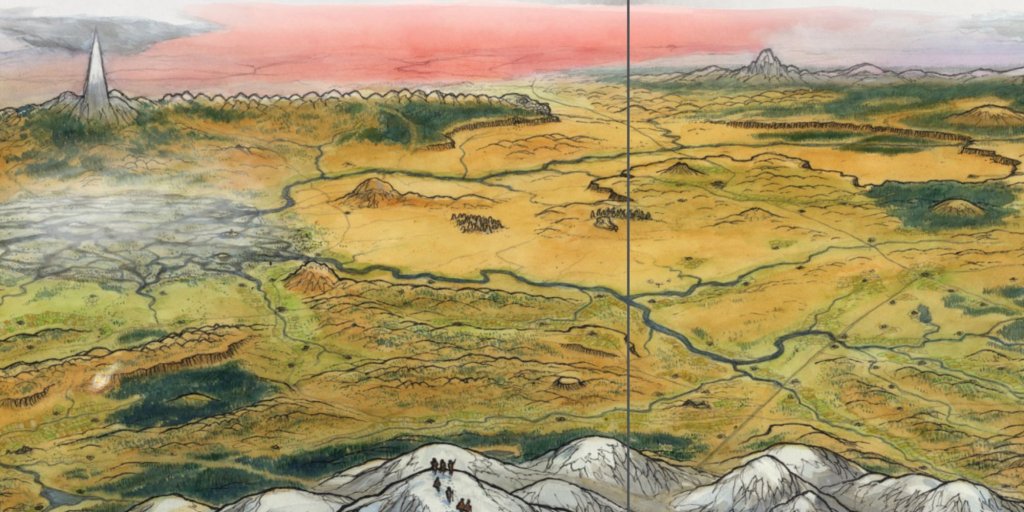
Dragon Pass is gorgeous. Each chapter is fronted with a two-page spread showing off the region, and the gazetteer is bursting with colorful and engaging illustrations. Flicking through, it’s difficult for me to find a spread which lacks art, a map, or at least a table to help present the text.
Better yet, the art’s direction and subject matter is nearly flawless. No, scratch that—I’ll go so far as to say flawless. Absolute A+ not just because of the art’s quality, but also because it blends beauty with function. This is how TTRPG settings ought to be presented.
Function, really, is the “secret sauce” to Dragon Pass’s artwork. Lots of publishers produce beautiful books. Dragon Pass stands out because the art is used to depict what adventurers might see within the world. My favorite example of this is the sweeping landscapes of Dragon Pass from a particular vantage point, as shown above. This creates an excellent blend of text and artwork by emphasizing the physical landscape.
Dragon Pass makes Glorantha feel truly real.
That’s not to say the artwork is an inactive picture of the geography. Similar to Weapons & Equipment, people in a variety of circumstances feature throughout this book.

On the textual side, Dragon Pass is quite accomplished. There are occasional errors, but these tend to be grammatical errors or infelicitous sentence structures—the kind of stuff which easily slips past a proofreader. It’s clear to me that Chaosium has done the work on this one, and is actively working toward improving textual fidelity (for example, in comparison to last year’s The Earth Goddesses). The editing and proofreading of Dragon Pass meets my expectations for a major TTRPG publisher.
In a similar vein, there’s a handful of locations in the book which aren’t on the map, and vice versa. For example, “Luck Top” near Muse Roost isn’t described, and the “Sporewoods” in the eastern Wilds seem to be just off the map when compared to my copy of Chaosium’s Trollpak reprint (1982). To be clear, it is pure coincidence I found “Luck Top” isn’t included—the name intrigued me, and I think Sir Ethelrist is interesting, so I went hunting and came up empty-handed. Pretty much every other time I went from the map to the book, or the book to the map, I found what I was seeking. Even if they missed a few spots the proofreading team certainly did its job cross-referencing this book.
Finally, I think it’s worth noting that the book’s ribbon has started unraveling.

Chaosium’s physical quality is usually excellent, but I’ve had this occur in the past, too. However those are also ribbons I’m reasonably sure my cat got his paws on; this one is not. (And a cat-proof book is beyond the scope of any publisher!) I’m inclined to think this unraveling is a fault in my specific copy due to Chaosium’s history of physical quality, but I felt it deserved mention even as an abnormality.
Conclusion
Reflecting over Dragon Pass, my attitude toward it is a bit mixed. Do I love it? No, I don’t think I do.
But do I need to love a RuneQuest book for it to be good? Also no—I’m not particularly affectionate toward the Guide, for example.
One of my personal “rules of thumb” is that if I want more from a thing, that thing is usually good. Subjectively, that’s pretty much where I’m sitting with Dragon Pass. I want more—more art, more maps, more spirits, more cults, more statblocks, more problems. However! That is not a realistic yearning for “more.” There is nothing in this book I would cut. Which means the only way it could have more would be making it longer—and Dragon Pass is already the longest book Chaosium has released for RQG since The Smoking Ruin & Other Stories (2019).
That said, I’m not just “logic-ing” myself into saying Dragon Pass is good. I don’t love it. I don’t think it will inspire years of adventure on its own.
But this book is so. Damn. Useful. For example:
- Want to find somewhere in Sartar? Dragon Pass.
- Want to travel from Clearwine to Crabtown? Dragon Pass.
- Want to lead a caravan through the Grazelands? Dragon Pass.
- Want to help the Lismelder retake the Upland Marsh? Dragon Pass.
This book does more than merely “accomplish its goal” in describing the Dragon Pass region. It is the lubricant which will facilitate years of adventure for gamemasters, Jonstown Compendium creators, and Chaosium itself. In just 30 seconds I can recall half a dozen times I would have been desperate for Dragon Pass over the last five years of writing and gamemastering RuneQuest stuff.
Dragon Pass may not be an exciting book, but it is absolutely essential for anyone wanting more information about Glorantha, and about Dragon Pass in particular. Like, if you told me I could keep the slipcase set plus one more book on my RuneQuest shelf for gamemastering, I’d probably pick this one.
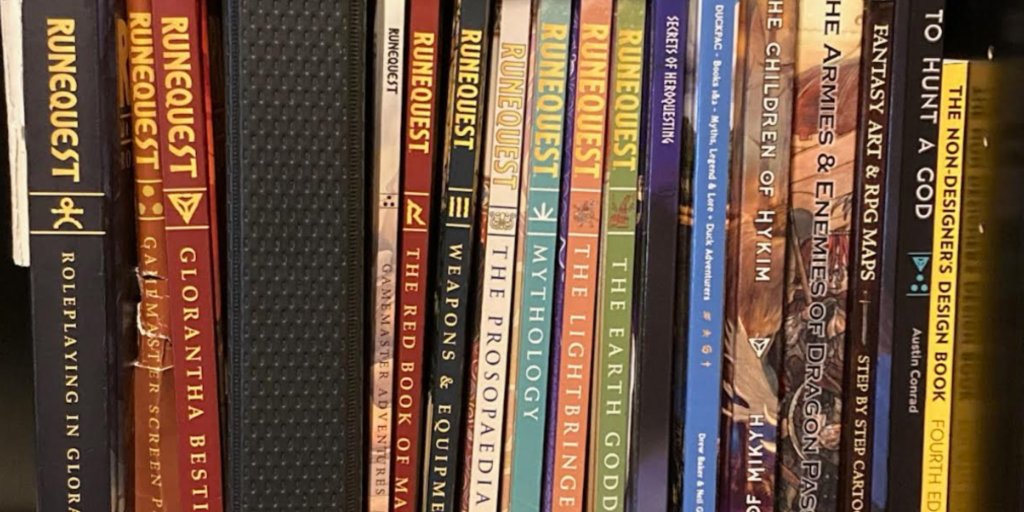
I can internalize a lot of cult information. I can “wing it” for different deities and cultures based on a general knowledge of their Runes. I’m never going to internalize the type of information in Dragon Pass because of its encyclopedic nature.
And this isn’t an essential reference just because I write stuff for RQG. It will make gamemastering easier. Imagine playing the title adventure of The Smoking Ruin & Other Stories with this map, with this information about the overland journey’s route. Or, opening the book and showing players how the world looks as they hike through the Quivin Mountains toward Boldhome.
Above all else, I see Dragon Pass as a tool for playing RuneQuest. And that’s exactly what it ought to be.
Lands of RuneQuest: Dragon Pass is available from Chaosium in hardcover for $44.99, which also includes the fold-out map and a free PDF. It’s also available in PDF on DriveThruRPG. (And yes, the files do include a PDF of the poster map.)
Want to keep up-to-date on what Austin’s working on through Akhelas? Go ahead and sign up to the email list below. You’ll get a notification whenever a new post goes online. Interested in supporting his work? Back his Patreon for early articles, previews, behind-the-scenes data, and more. Or head over to DriveThruRPG to peruse his publications!
You can also find Austin over on Facebook, and increasingly more often on Twitter.
 Akhelas