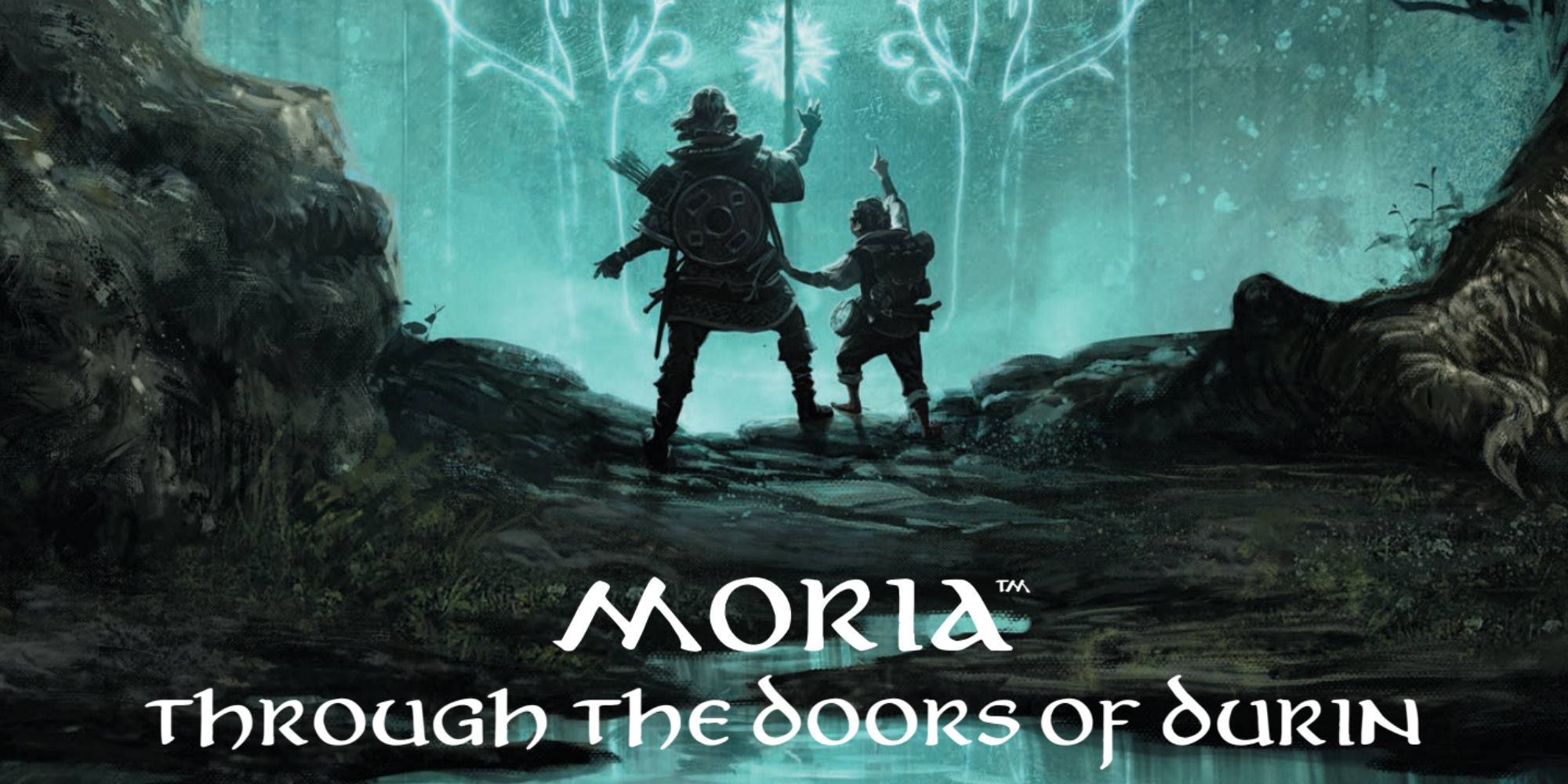
What “dungeon” has greater claim on the fantasy imagination than Tolkien’s Moria? The ancient city and mines of the Dwarves—and the Fellowship’s journey through it—is the backdrop upon which practically all lost cities or labyrinthine mega-dungeons are created. From Earth’s past, only the mythic Labyrinth of Minos or the historic discovery of “wonderful things” in Tutankhamun’s tomb by Howard Carter strike my mind with similar preeminence. Of TTRPG ruins, only the legendary Tomb of Horrors for Dungeons & Dragons even comes remotely close to Moria.

Understandably, when Swedish publisher Free League revealed a Moria book for The One Ring 2E (TOR) I was rather intrigued.
Describing the ur-mega-dungeon in an exciting and useful way, while still respecting Tolkien’s work, is a hell of a lot to ask. I deeply admire The One Ring’s core rulebook for its blend of theme and mechanics. However, my opinion on the subsequent adventure books (one, two) was positive but less enthusiastic.
So how does this new work compare? Even if it lives up to TOR, can it possibly live up to Moria itself?
I’m surprised to say it, but … yes.
Disclaimer: While I purchased this book as a backer of the crowd-funding campaign on Kickstarter, I do occasionally receive review copies from Free League. This review may contain spoilers, but most spoilers are pretty predictable if you’ve read the book—it is almost certainly safe for players to continue reading.
Oh, and as you may have guessed, this review is only about the TOR edition, not the 5E edition.
What’s Inside Moria?
Moria – Through The Doors Of Durin is a 225-page hardcover which describes 26 “Landmarks” throughout Moria, new journey rules for traveling under the mountain, guidance on different types of campaigns utilizing Moria, and a host of villains and monsters which will confront the Player-heroes (including, of course, the Balrog, Durin’s Bane himself). The book’s premise is that a holistic description of Moria is functionally impossible. Instead, it uses TOR’s Journey rules to structure exploration of the ancient city through reaching these points of interest and engaging in adventurous mischief while there.
Trouble along the way uses TOR’s Eye of Mordor mechanic to measure when dangerous events occur. This is analogous to random encounters in other systems or campaigns. This metric increases based on the events of the adventure, and finally returns to its baseline after a Revelation episode. These episodes are detailed for the Loremaster—you don’t have to constantly invent them on the spot—and are designed so that eventually, inevitably, the Balrog becomes aware of interlopers.
Hope, heroism, and despair intermingle in Tolkien’s work. Indeed, this is one reason TOR won my admiration. The game handles those themes with expertise. In contrast, the Moria book emphasizes horror and despair. There is very little hope under the Misty Mountains. Light is not absent from this campaign, but the atmosphere is bleak.
But that suits Moria, doesn’t it? Few places in the Third Age are so filled with evil. Indeed, this is why one campaign option presented to the Loremaster is a short delve for a single mission, or a desperate journey through the dark akin to that made by the Fellowship. Full campaigns in Moria are possible, but the city’s darkness is such that the authors are aware of a need to balance it with experiences elsewhere of good and light.
Moria is filled with creatures of the Shadow, but it is not a one-note depiction of miserable villainy. The orcs are divided into roughly three factions: local Moria-orcs associated with Gorgol, warlord of the Misty Mountains; recently arrived Mordor-orcs sent by Sauron; and the crazed cultists which worship the Balrog. Within each faction are many flavors of evil. Pretty much all are properly reprehensible—there are no “shades of grey,” and there should not be—but there’s quite a bit of tonal difference between a welcoming and cheerful sadist and a maliciously devious goblin matriarch. In particular, the Balrog’s cultists have a nicely apocalyptic touch which emphasizes their religious or mystic zeal.
Although only a fool would really trust an orc, the existence of factions does allow for political schemes, skullduggery, and “divide and conquer” strategies. With, however, the very important footnote that the Balrog is still the freaking Balrog. It’s quite possible for Player-heroes to create shifts in power through manipulating the villains’ selfish schemes, but this “dungeon” cannot be cleared of evil without addressing the spirit of shadow and flame.
Now, the Balrog has a statblock. Historically, if you give something a statblock, that means players will try to kill it. There’s even an extraordinarily difficult subplot threaded throughout the Landmarks which may make this possible. I had mixed feelings about this, but the authors were one step ahead of me.
“The Balrog is a foe beyond the power of almost anyone who still dwells in Middle-earth. So too, though, was Shelob, the last daughter of Ungoliant, and it was a humble gardener from the Shire who dealt her a grievous wound. The workings of Fate are strange indeed, and it is possible, if exceedingly unlikely, that the Player-heroes might battle the Balrog and win.” ()
Moria – Through The Doors of Durin, page 172
The battle with Shelob is hardly an obscure reference. However, it’s this type of attention to detail—attention and respect given to Tolkien—which really makes both Moria and TOR excel. The game is set in between the events of The Hobbit and The Lord of the Rings. It generally assumes that the Player-heroes can meaningfully impact the world, but ultimately Sauron’s evil will only be driven back by the canonical destruction of the One Ring. A great deal of attention is paid to the events which take place “off-screen” between Tolkien’s novels, as well as how the players’ choices might impact those stories. I feel the level of research and respect shown here is rare among adaptations from source material.
(And no, I’m not trying to specifically call out The Rings of Power. I’m thinking more broadly of all the terrible book-to-X adaptations ever made by someone with an urge to “improve” old stories.)
That said, the authors of Moria also account for change. Respect and faithfulness are shown because they are valuable. However, there’s also a slim possibility of vanquishing the Balrog! A sentiment of “respect Tolkien’s work, but change the story if needed for your table” pervades the book. Options to surprise players over-familiar with the work are presented. Moria isn’t afraid to introduce its own schemes and plots into Middle-earth, either. Indeed, I wouldn’t even characterize these additions as “cautious!” They work because, throughout, the entire book’s ideas feel like they could have been sub-created by the master himself.
Production
Moria is well-illustrated with primarily “sketch” style character portraits and Landmark maps, combined with a full-color spread for each major section. Just flicking through my copy at random, it’s hard to find a spread which lacks any adornment. While I’m not sure I’d call the book “gorgeously illustrated,” especially when comparing to the vibrant full-color, like RuneQuest, prevalent in the TTRPG industry.
Neither would I call Moria “stingy.” The art is frequent, good quality, and matches the style of other books in the TOR line. In particular, I feel the character portraits in Moria capture more personality in their villains than in other books from Free League.

And of course, the map of Moria is fascinating. For a product structured around exploration—but which avoids the classic “walk down the grid-map hallway” style—the map is deliciously detailed with chambers and passages. This, plus the vertical cutaway, adds a real sense of scale without urging players to track their location precisely.
That said, the choice of locations featured on the map is somewhat odd. Each Landmark in Moria is either Famous, Hidden, or Obscure. However, for a map intended to be seen by both Loremaster and the players, it feels weird that Hidden locations are often listed. I think separate player-facing and a Loremaster-facing maps may have worked better (kind of like the player-facing and Loremaster-facing maps in the endpapers of TOR’s core rules). The map’s extent works, but the labeling of locations is a bit odd. There’s also some Landmarks I felt able to deduce on the map from their description, but didn’t have a label because they’re Hidden or Obscure. So again, two maps may have resolved some infelicities.
The textual polish throughout is excellent. I don’t recall spotting any typos, and just a handful of grammar errors or weirdnesses. In particular, I also like that the text has a good grasp on when to offer a light-hearted aside and when to focus on straightforward description. These asides aren’t especially frequent. Which is good! When they are used, their infrequence improves an aside’s ability to add humor (usually through a direct Tolkien reference).
Conclusion
Free League’s Moria – Through The Doors Of Durin is the definitive description of fantasy’s most famous dungeon. It’s a beautiful, engaging book which is well-designed for use in a variety of The One Ring 2E campaigns, ranging from short adventures underground to long treasure-hunts and even attempts to reclaim the city.
(And I haven’t even mentioned the 30-page solo-play campaign structured around Balin’s expedition!)
The approach in Moria wouldn’t work for describing a mega-dungeon in many systems or settings. It works here because, like TOR as a whole, the book is targeted toward providing a specific play experience to evoke the themes present in Tolkien’s stories.
This precision is one of the book’s greatest strengths. I think it would have been quite possible—and quite successful—to attempt writing out Moria in a more traditional “dungeon-crawling” manner. Perhaps the 5E edition does; I don’t know. Doing so would at least triple the work’s length without really crafting a specific gameplay experience.
What we have here isn’t just a dungeon—it’s Moria, really Moria, in a way that you can explore it with your friends. I’m kind of amazed by that.
Now, let me rein myself back in a little. Is this book going to be a genre-defining classic? No. Is it going to live immortal in our imagination? No. If you aren’t into Tolkien’s work, and you aren’t interested in TOR, this book doesn’t somehow reinvent the “mega-dungeon” in a way everyone needs to study and experiment with.
Do you like Tolkien? Do you like TTRPGs? Well, in that case my answer is easy: you’ll love Moria. Full marks—a really great campaign.
Moria – Through The Doors of Durin is available in hardcover for about $45.00 directly from Free League (which includes the PDF). The digital edition is available for $24.99 on DriveThruRPG (and hey, that’s an affiliate link, so if you use it you’re fueling my ability to continue inflicting my opinions on the internet; thanks!).
Want to keep up-to-date on what Austin’s working on through Akhelas? Go ahead and sign up to the email list below. You’ll get a notification whenever a new post goes online. Interested in supporting his work? Back his Patreon for early articles, previews, behind-the-scenes data, and more. Or head over to DriveThruRPG to peruse his publications!
You can also find Austin over on Facebook, and increasingly more often on Twitter.
 Akhelas
I 100% agree with your general assessment, with two quibbles. First, the art really nails it, for me, feeling very much in line with the fairy tale book feel of the actual physical book (paper quality, colors, etc). But I respect that is a very subjective question. While Iike a lot of RuneQuest’s art, I generally prefer this sketch/pencil art style. My favorite ttrpg art of all time is in the 2006 Werewolf the Forsaken line, so there you go, lol.
The other quibble is that I think it IS a groundbreaking look at the megadungeon format suitable for “modern” games, where the dungeon serves a purpose and isn’t the end in-of-themeslves. I honestly wish RQ would adopt something similar in the future… but I’m also very much a GM (and player) who despises dungeons, so I may be rarer than I like to think, lol.
LikeLiked by 1 person
I note your comment viz “textual polish”, and very happy to see that. Our group largely plays RQ and given a number of us are current or former business analysts, we often see ambiguity that could be readily avoided. Clarity is the enemy of the rules lawyer!
LikeLiked by 1 person
Agreed! Clarity is such a bugbear/Balrog/Cacodemon (pick based on your preferred system/setting). As someone who cares about words, I try taking the time to consider their execution when reviewing a book. Good proofreading is practically invisible, but deserves a great deal of praise.
LikeLiked by 1 person