
Note: Just as with my Harnworld review last year, I received my copy of Kingdom of Melderyn as a gift from my friend Ludo (of God Learners infamy) as he continues—successfully—to proselytize the world of Harn.
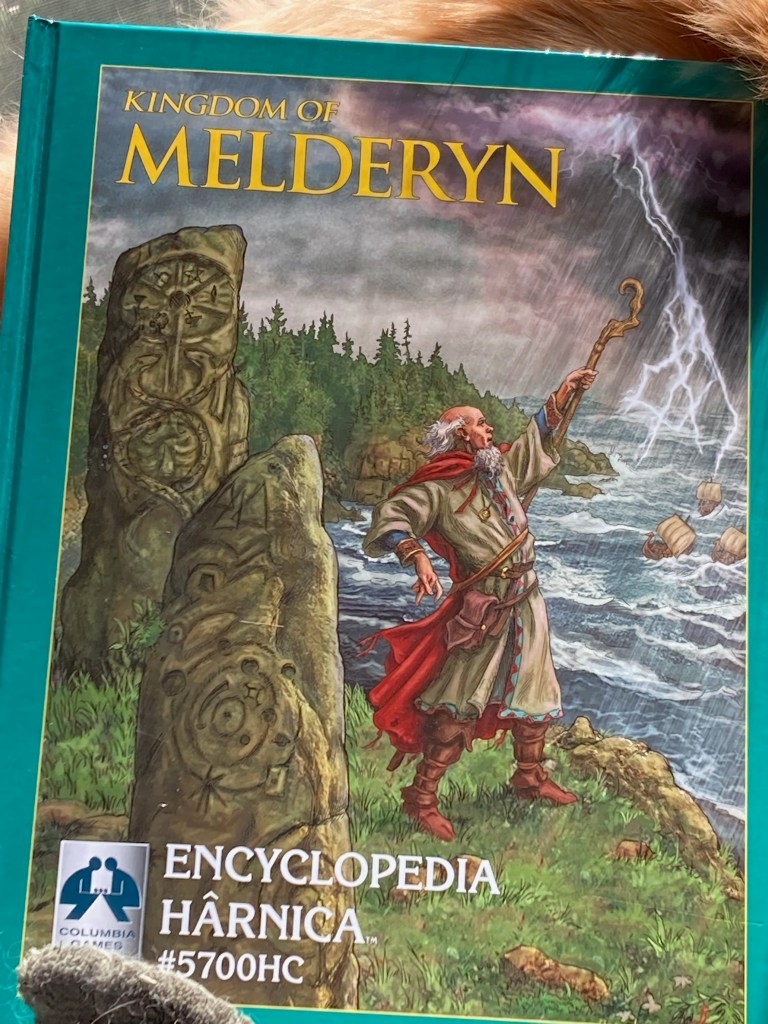
The kingdoms of Harn—the “believable, stable, and rational” medieval fantasy setting published by Columbia Games—are currently being made available in hardcover for the first time in the setting’s history. Traditionally, Harn was published as looseleaf articles allowing each gamemaster to transform a three-ring binder into their personal Encyclopedia Harnica.
Today, we’re taking a look at the Kingdom of Melderyn.
What’s Inside?
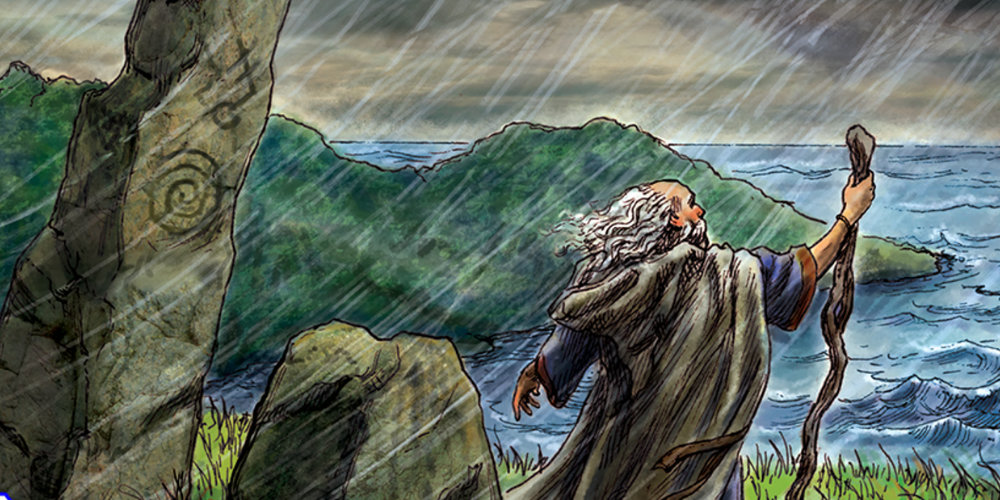
Kingdom of Melderyn is a 128-page hardcover which contains three articles:
- The titular article about Melderyn
- Its capital city, Cherafir
- And Thay, an important port
Naturally, the bulk of the book—around half the page count—focuses on describing the kingdom itself. The structure covers the same topics as those found in the HarnWorld hardcover, with an overview followed by history, politics, religion, economics, and societal information (such as food & drink).
Following this is a comprehensive gazetteer of the kingdom’s major settlements. These descriptions utilize the same tight editorial control to present basic information together with seeds of problems and adventures on a single page. While the type of information in the text isn’t necessarily unusual to a TTRPG supplement, the textual quality is rare indeed. While—like HarnWorld—this book doesn’t “wow” me right off the page, it’s clear from reading any of these entries that the text received quite a lot of time and attention to get it just right.
Each gazetteer entry is supplemented with a list of all manor villages associated with the settlement, the settlement’s heraldic shield, and its position in the kingdom’s feudal structure. Most entries also include a portrait of the settlement’s ruler. Flicking through the book, these portraits tend to blend together. However, when reading through the volume there’s actually quite a lot of character from one to another.
All told, to my count the gazetteer summarizes 29 separate settlements.
Two of these settlements are then described in further detail: the cities of Cherafir and Thay.
Once again, each city’s history, politics, etc. are presented at the start of each article. It’s worth noting, however, that although similar ground is covered throughout the Harn articles I’ve read, it’s rare that they’re merely copy-pasted. Most articles present familiar material from a more local perspective, offering additional detail.
For example, a pirate attack known as The Rape of Thay is described in HarnWorld, Melderyn, and Thay. While HarnWorld specifies that a man named Alegar planned the Orbaalese attack, Thay instead describes the defense of Tarien Wharf in the city. I’ve found that, in general, this specificity strengthens Harn’s presentation.
Like Melderyn, each city article is largely focused on describing places to go and the people who live there. Each city is split into separate districts, and numbered maps of buildings describe each section at length. The only supplement I’ve ever really encountered which strives for this level of detail is Pavis: Threshold to Danger for RuneQuest 2. I wouldn’t be terribly surprised if Pavis inspired this mode of presentation for 1983’s original Cities of Harn.
That said—and after a quick flick through Pavis to double-check my opinion—I’m rather confident I prefer the use of this approach in Cherafir and Thay. I find Harn’s location entries more enticing, and there is greater control of when to describe a particular building. For example, pretty much every building in Pavis is numbered, while the level of detail for particular districts varies somewhat in Cherafir. The detail in the Alienage is intense, while that in residential Erebir is more scanty. And that makes sense to me—the Alienage is where players are most likely to run amok!
Each city’s article is concluded with a series of appendices detailing a specific building’s inhabitants and problems. Checking on Columbia Games’s site, I do see that these were originally published as separate articles, now integrated into the city’s description. These appendices feel moderately like an “adventure site” due to the zoomed-in detail (including not-a-battle maps). However, from the particular locations chosen—like a clothes shop or a herald’s college—I’m inclined to think they’re rather intended to provide close detail. Story hints throughout the text may well inspire adventures, but the building appendices themselves, on average, don’t seem intended for swashbuckling break-ins.
Production
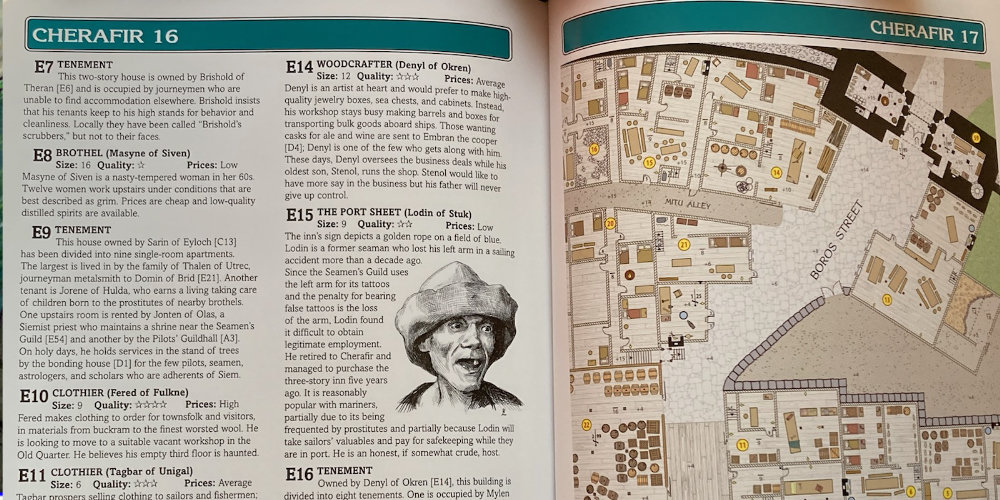
The production quality of Harn remains quite good. Kingdom of Melderyn is comparable to HarnWorld in quality of art and attention to detail. Much of the illustrations are black-and-white portraits, and many of them are, frankly, ugly.
However, I think this is an intentional stylistic choice. More than that, by the time I finished reading Kingdom of Melderyn I’d come to admire the work’s art direction. The art is often ugly. People are often ugly. Especially without modern dental hygiene or growing up on a medieval diet! There’s no sense of “nobility” versus “villainy” in many of the illustrations. That surprised me, but pleasantly so. I’m so used to stylized or “perfected” and “beautiful” depictions of people in most TTRPG supplements that Kingdom of Melderyn caught me off-guard.
I wish more games would try this approach. As the Harn’s hyperfixation on realistic medieval detail, the extension of that to portraying average and everyday people strengthens the reader’s immersion.
Finally, the interior maps definitely deserve a spotlight. Mostly located in the appendices or in Cherafir’s Alienage, the interior maps are an intimidating and impressive work of game design. They feature standardized presentation of details from wall material and ceiling heights to the location of random bits of furniture throughout a room, to even the location of supports for higher stories. Once again I doubt I’d call the maps “attractive,” but in particular utility is of more import for a map than aesthetic pleasure. The only potential hindrance in utility, ironically, is that for a novice like myself processing all the information is more “distracting” than “intriguing.”
As mentioned previously, the textual quality of Kingdom of Melderyn is excellent. The editorial work goes beyond proofreading into genuine attention to the organization of information, placement in layout, and care to provide exactly enough detail to intrigue. I spotted occasional typos, but I’m rather confident that’s only because I’m a bit anal about this sort of thing.
Overall, the quality control in Kingdom of Melderyn ought to make any publisher proud, at any size in the TTRPG industry. If someone asked me “how well-polished should TTRPG text be?” I’d just point them in Harn’s direction.
Conclusion
Kingdom of Melderyn is very cool. The book presents various levels of Melderyni society throughout its content, and is chock full of interactions, campaign ideas, and story ideas. The supplement is a strong follow-up to reading HarnWorld because it strengthens the notion that Harn could be a living and breathing world. Reflecting back over the work, it’s actually difficult for me to find a substantive critique of this supplement’s content.
If you’ve read much of my critical work, I’m aware that’s, uh … not common.
That said, I do have some smaller criticisms worth mentioning.
As with HarnWorld, there is no table of contents, standard page numbers, or index in Kingdom of Melderyn. Instead, each article has its own pagination to cohere with the looseleaf style. While reading HarnWorld I found this mildly annoying. Flicking back and forth while reading Kingdom of Melderyn, I found it absolutely vexing.
For example, while reading Thay’s appendix about a ruined temple, if I wanted more information on Melderyni religion I’d need to flick through Melderyn until I found the “Religion” section instead of using a table of contents to quickly find the right spot. I’m not entirely sure how long-time Harn aficionados navigate their material in looseleaf—I get the sense that PDF is the best format for this “article” style due to the almighty powers of Ctrl+F.
I’m sort of puzzled that a close-detail map of the actual island of Melderyn doesn’t appear to be available. An excerpt from such a map is provided at the end of the Cherafir article—which includes the names of all the villages, manors, etc. which cluster around Cherafir—but the only Atlas Harnica map for Melderyn is close detail for M8, the square south of Thay. Publishing the map sections for Thay and Cherafir kind-of feels obvious to me?
Also, I’ve found something of an infelicity in the storefront—I thought Melderyn would include the Arcane Lore article since it was originally printed in the “Melderyn Kingdom Module.” However, I now suspect that refers to an older module, not the Melderyn currently available from Columbia Games.
(As an aside, I instead snagged the articles for Kelestia and the Godstones and wow, Harn is able to be weirder than I expected! Exploring more of Harn’s magic and metaphysics is definitely on my radar.)
Finally, I do think it’s worth briefly discussing the price of Kingdom of Melderyn. The hardcover runs $59.98, and does not include the PDF version. I’m not an extremist about Print and PDF bundles. When a product is higher-than-typical price for its length (and lacks overtly expensive-as-hell artwork to demonstrate production costs), plus to some extent includes reprints or expansions upon previously-released material, I think it’s reasonable to ask “why not bundle the hardcover and the PDF?”
This, I suspect, is founded upon the publisher’s sale of looseleaf and PDF articles at the same rate (plus shipping for physical products—entirely reasonable). From the quality of the two articles I’ve received, I’d guess that they’re offset-printed, not printed “in-house.” So there probably is a material cost to production which is then mitigated by PDF sales.
Further, it is a legitimate explanation that a publisher’s sales necessitate higher prices. A small, dedicated audience—like Harn—willing to pay a bit more for what they want isn’t necessarily a bad thing. It keeps the publisher open. Based on the numbers of backers for Columbia Games’s Kickstarters for Harn (publicly available), my educated guess is that these prices are necessary based on the audience’s size.
For some context the Harn Kickstarters run about 500–600 backers, and in my own RuneQuest work I tend to calculate that a “safe” audience estimate is 150–250 purchasers. Sales past that are very exciting, because they’re what contributes to keeping the cat fed rather than covering production costs. So with a larger operation—albeit with very generous fans—I do feel increasingly confident Harn’s prices are “necessary,” not “we can get away with it.”
All that said, Kingdom of Melderyn is indeed a fair bit cheaper than its constituent articles! The looseleaf articles for Melderyn, Cherafir and Thay would cost $84.94. Compared to the hardcover, that’s a tasty 30% discount.
Still, Kingdom of Melderyn remains expensive for its length. Is the quality good enough to justify the premium price?
I’m inclined to say yes. Naturally, this is going to vary depending on your preferred style of TTRPG world and worldbuilding. But there’s very high quality here which is substantial, not just artwork-deep. I can definitely see myself buying one of these hardcovers and feeling happy with the purchase, not begrudging the expense.
Or more likely buying HarnMaster Magic—I’m fiendishly curious about the setting’s magic system after the hints in Melderyn. It is an island of wizards, after all…
Want to keep up-to-date on what Austin’s working on through Akhelas? Go ahead and sign up to the email list below. You’ll get a notification whenever a new post goes online. Interested in supporting his work? Back his Patreon for early articles, previews, behind-the-scenes data, and more. Or head over to DriveThruRPG to peruse his publications!
You can also find Austin over on Facebook, and increasingly more often on Twitter.
 Akhelas
Ah, Harn. The only setting that rivals Glorantha and Middle-earth for depth in my opinion. Of course each of these has a very different flavor of depth, focused on very different things, so ultimately not comparable, but still. The Harn magic is pretty cool. I hope to see an article when you get into it
LikeLike
At this point, it’s almost certain that I’ll write about HarnMagic once I pick it up. Based on the depth seen thus far, I’m quite intrigued about how magic will be presented.
LikeLiked by 1 person