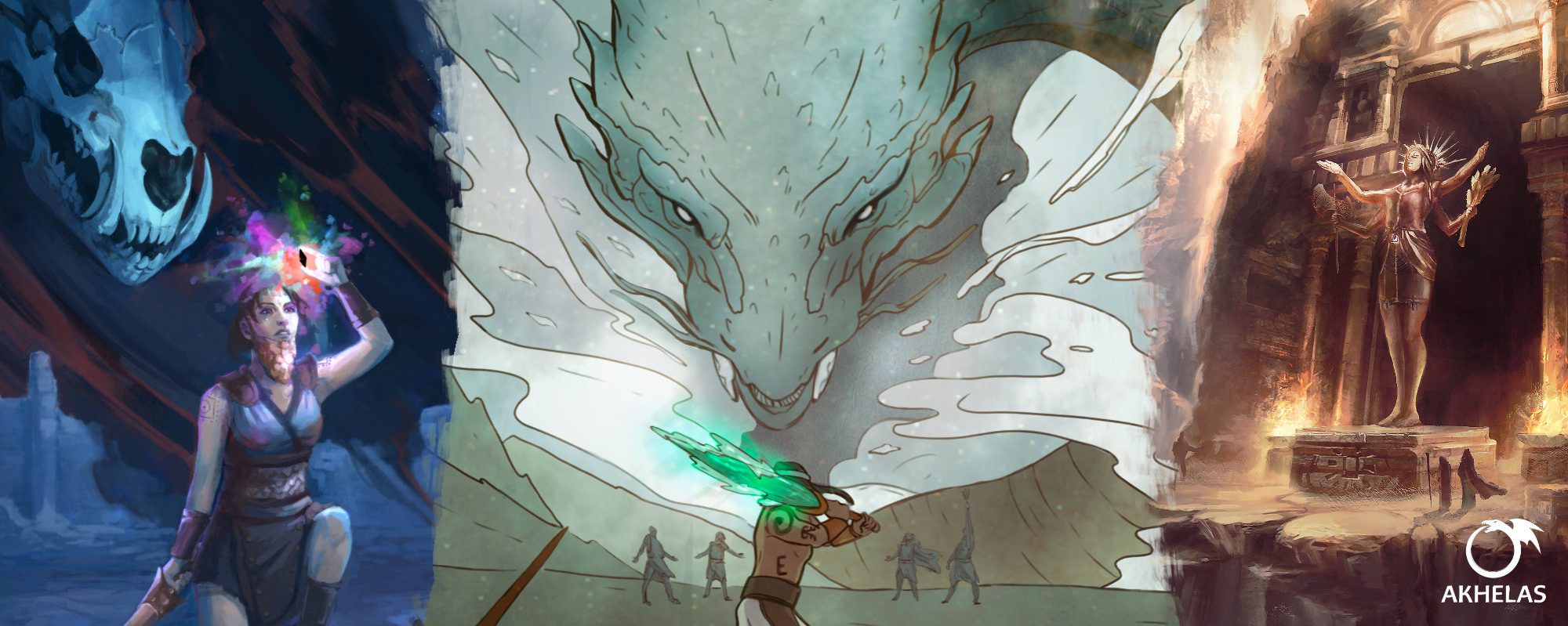
If you’re in the RuneQuest groups on Facebook or Reddit, then you may be aware the Wolf Pirates campaign I’m gamemastering slid down a long heroquesting rabbit hole. Heroquesting is pretty central to roleplaying in Glorantha because it’s a nearly-unique element of the setting. It’s a way to explore the setting’s fascinating—and sometimes obtuse—lore through adventures. Yet how to play a heroquest has been debated since, literally, before I was born. Few tabletop games have a topic which is so widely explored, so central to a setting, so frequently talked about, without achieving consensus on the basics.
My game delved into heroquesting because the concept intrigues and excites me. When organizing the campaign, one of my semi-secret gamemaster agendas was creating a story arc in which both the players and their adventurers learned about heroquesting. This built upon our Session Zero concept that it’s possible for adventurers, eventually, to tussle with major non-player characters. Heroquesting isn’t just “a way to power up.” However, this type of magical adventure is reasonably associated with magical rewards and powers. So for the adventurers to have the potential our group wanted, I knew they’d need to dabble in the Hero World.
Today I want to share some concepts which I’ve found helpful when gamemastering heroquests at my table. I hope this helps others dive head-first into this type of adventure!
This certainly isn’t a concrete “Heroquesting 101” guidebook. My thoughts on the topic are still evolving and changing as I read and play in Glorantha. Focusing on these ideas should, I think, reduce the illusory barrier of lore and mechanics which a lot of people perceive between RuneQuest adventures and special heroquests.
A few influences in particular ought to be shared and celebrated:
- Simon Phipp’s Secrets of HeroQuesting is my go-to reference manual on the topic. I’ve deviated quite a bit from Phipp’s approach, but still recommend him highly.
- Andrew Logan Montgomery’s Company of the Dragon contains a good deal of information about heroquesting. Both his Six Seasons in Sartar and The Seven Tailed Wolf also include useful advice. Company is the heart of his work, for me, and one of my better “toolboxes.”
- My friend Mason J. Street playtested To Hunt a God with me, during which many of my concepts were helpfully put to use (and a few melted down for reforging).
- Ludovic Chabant (of God Learner infamy) gamemasters a campaign in which my adventurer discovered the hidden Truth about the Spike, slew Cacodemon with a Firespear, and transformed into the Cow Goddess. These experiences have been … formative. Also he tolerates me playing a trickster, for which he is owed much glory and consolation.
Overall, much of this article has been said before, in both similar and different ways. Some of it draws on ideas inspired from interactions with these lovely people, some of it from other games, and some of it from random stuff I’ve read but can’t recall the source. This is not an original approach. It is, I think, an approach which can help you start heroquesting right away.
The Central Metaphor
One descriptive metaphor returns to mind again and again while gamemastering heroquests: augmented reality (AR) goggles.
Basically the adventurers have two sets of perceptions: the Middle World and the Hero World. The latter is the world of wonder and horror which adventurers navigate during heroquests. Combining perceptions this way does not disorient the adventurers—I assume they’ve experienced this on occasion. The most common incident is initiating into their god’s cult prior to adventurer creation.
Adventurers perceive themselves in the Hero World as whatever role they hold in the myth. This can be intentional or unintentional. For example, during an initiation to Ygg the Pirate God, our Magasta player put on a squiddy costume and rolled against his Death and Water Runes to see how well he represented his deity. Meanwhile, the other pirates just saw the adventurer glowing with the “hero light” as a signifier that he was on a heroquest. If you randomly meet someone glowing like that, watch out! You could get sucked into their myth.
In a recent session exploring the Sky, most of the adventurers perceived themselves as generic “golden warriors.” They didn’t control their initial Hero World appearance because a magical effect more or less launched them into the heroquest—they hadn’t prepared for the incident. As actions distinguished the adventurers, though, their appearance changed. For example, one adventurer led a platoon of golden warriors against dark trolls which assaulted the Gate of Dusk, so his appearance shifted to that of a Solar noble. Another adventurer augmented her Battle Axe skill with the Death Rune, so it was revealed that she had been Babeester Gor (the adventurer’s goddess) all along!
Recently, I’ve been implanting emotions, memories, and knowledge through this metaphor as well. The adventurers know that such things are “fictional,” and the players are not required to act on them. Player and adventurer agency remains wholly in control. What these “mental” elements of the AR goggles provide is clues and context. I’m finding this is more immersive than “well, what you know is…” The players feel less like I have to explain what they should already know, and more like this knowledge is coming from “somewhere else.” Their experience is that heroquesting can be weird and creepy! I like that.
Heroquesting is RuneQuesting
Heroquesting within this metaphor about perception is very simple. Use the RuneQuest rules. That’s it; you’re done.
The reason I find the AR goggles metaphor works is that the adventurers don’t have to fiddle with getting the right role, using the right abilities, or things like that. When our Babeester Gor adventurer swings her axe, her golden warrior persona stabs with his spear. And so on.
I’m happiest with this for when the adventurers are in a relatively generic role. I do feel that trying to be Babeester Gor with a Battle Axe of 10% is kind of weird. We’ll cross that bridge when we come to it, and I’ll learn something new. (My gut thought is that if an adventurer is intentionally in a role, using an ability which doesn’t match between the two worlds has a penalty. Maybe the result is even 1 level of success worse!)
The point, though, is that utilizing the metaphor means the gamemaster doesn’t need to come up with special rules. You can just go heroquesting.
In my experience, a majority of the “specialness” about heroquesting can be captured through narration rather than mechanics. Add magic to the descriptive use of abilities, and the adventuring experience becomes magical. For example, my current game’s exploration of the Sky doesn’t require understanding how the adventurers’ abilities work while in the Hero World. The players just know they got sucked into a magic painting, and now are trying to cope using their own abilities.
This brings us to…
Heroquests are Proportional
Another hurdle I experienced—and which I believe others share—is “gods are big and scary.” Instinctively, it feels natural that encountering a deity should be overwhelming. Becoming powerful enough to seduce a goddess or slay a Terror feels like it ought to require huge skill percentages and immense magic. Yet a fundamental aspect of Gloranthan mythology is the adventurer’s personal experience of the stories. An Orlanthi farmer doesn’t “know” the Sun rises and sets because Orlanth slew it long ago. He believes it because the farmer, personally, held the sword and murdered the Sun to quench the pains of his own Love for Ernalda.
We overcome this hurdle by recognizing that challenges during a heroquest are proportional to the adventurers. Everyone is capable of great deeds because the Hero World responds to the adventurer. Initiates experience challenges which are roughly equal to their abilities, while Rune Lords and demigod Heroes often combat opponents with their own might. At times, there are foes far beyond the adventurer’s abilities. Just as in the Middle World the adventurer automatically understands they should stay the hell away. Proportionality is not “every antagonist’s skills are similar.” Rather, it suggests that most challenges are those which the adventurers could accomplish. Attacking a hugely dangerous Earth Giant might be foolish, but the encounter remains proportional if alternatives are available. Maybe the adventurers feed it until it sleeps, or simply sneak past.
In the end, this means all heroquests require from the gamemaster is creating (or running) a normal adventure. Most of the difficulty is due to perspective, not mechanics. Details on how to start or create heroquests are outside our scope since I’m not writing an actual guide to heroquesting. (Yet.) Lore, however … I really do understand why lore feels like a hurdle. There’s such a quantity of mythology that it feels very easy to “get it wrong.” That’s why my last suggestion is that…
Heroquests are Cartoons
A lot of writers try to reference myths, epics, and other world literature when describing sources of inspiration and experience for heroquesting.
They’re all wrong.

And yes, I will actually go to bat for that claim. That’s maybe the only statement in this article with which I’m confidently in agreement. I adore ancient mythology and epic, but Looney Tunes is both more relatable to us moderns and more relevant to Glorantha’s tone. The short, punchy narrative of a cartoon with its strangely illogically-logical narrative leaps is perfect practice for understanding heroquests. This doesn’t go only for classic cartoons. Modern stuff like Spongebob or Smiling Friends also nails it. However, most anime doesn’t, and many adult cartoons don’t as well. The key piece is the presence of single-episode narrative, and the lack of multi-episode narrative. No matter what Jerry does to poor old Tom, in the next episode Tom is back at chasing the mouse.
Kind of parallel, you know, to how our Orlanthi farmer looks at the ever-dying Sun.
That doesn’t mean every Gloranthan myth is funny. Many cartoons are sad, not funny, on purpose. (Look again at Tom & Jerry:as a kid we laugh at Jerry, but many of us sympathize with Tom as adults. Or worse yet, laugh and sympathize.) I’ve rarely encountered any tale which is as heart-wrenching as Futurama’s “Jurassic Bark.”
Understanding cartoon-logic helps us understand myth-logic because both narrative forms rely heavily on stereotype, repetition, and surprise. We know the basics of each character’s personality. An episode doesn’t try to define Spongebob. It just shows how he, Patrick, and other characters are interacting that day. As a gamemaster, when I’m narrating the magical experience of using abilities in the Hero World, I think about how they’d look in a cartoon. What are the consequences? In what way are they overdramatized? This leads to moments such as turning into a cow to avoid paying taxes, or all of an adventurer’s hair falling out because—to avoid being shaved—he invoked the Trickster (yes, both anecdotes happened in actual RuneQuest sessions).
Another helpful aspect of using cartoon-logic is that it reframes our gamemastering to focus less on lore, more on the story happening on the tabletop. Since they’re two different media, our mind doesn’t grasp at the same tools and ideas. Trying to use myth-logic is less effective because “myth” is too similar a mental category to Glorantha. We stumble into the cage rather than walk through the painted door. Most of our Sky adventure has been improvised along these lines. I didn’t know what the Sky might look like, so I said there’s a huge, comically long corridor, with a 4-way checkpoint at the end. As we roleplayed, we discovered that the entire Sky Dome is built out of these corridors. At least, during this heroquest—I really want to explore the blue Sky’s ocean some day! During play, I realized the “golden warriors” being generic could actually be to my advantage. I discovered that they need someone to lead them, to take authority, Solar-style. This enabled player agency as leaders and heroes, if they chose to act.
Viewing heroquests as cartoons provides just enough narrative structure to not get lost. It retains spontaneity and, perhaps most importantly, gives the gamemaster a familiar touchstone to rely on. Not everyone knows the Mahabharata or the Iliad, but nowadays most everyone’s childhood included watching cartoons. If you’re looking for further structure, my advice is to consider the Runes themselves. They’re basically “building blocks” for ideas and adventures. The Runes are one reason Glorantha resonates so deeply. When in doubt, don’t think about a particular deity’s myths or relationships or Passions—think about the relationship of the Runes to one another. Fire/Sky dominates the Earth, and is vanquished by the Air. Darkness is cruel, or it can be secretive, or it can be patient. Play with the RuneQuest core rules’ listed associations for personality, sense, animals, etc. My games tend to have a lot of snake-adjacent Earth goddesses because, well, it’s easy to reach in my toolbox!
As you start heroquesting, always remember: yours is the only true Glorantha. Mine isn’t the true Glorantha, Chaosium’s Glorantha isn’t the true Glorantha, neither is the Glorantha published by any other RuneQuest author. The only true Glorantha is the one explored at your table.
Want to keep up-to-date on what Austin’s working on through Akhelas? Go ahead and sign up to the email list below. You’ll get a notification whenever a new post goes online. Interested in supporting his work? Back his Patreon for early articles, previews, behind-the-scenes data, and more. Or head over to DriveThruRPG to peruse his publications!
You can also find Austin over on Facebook, and increasingly more often on Twitter.
 Akhelas