Ever wonder what life is like for the Orlanthi who live under the Lunar Empire’s oft-oppressive rule? Edge of Empire is the supplement your RuneQuest: Roleplaying in Glorantha (RQG) campaign is seeking.
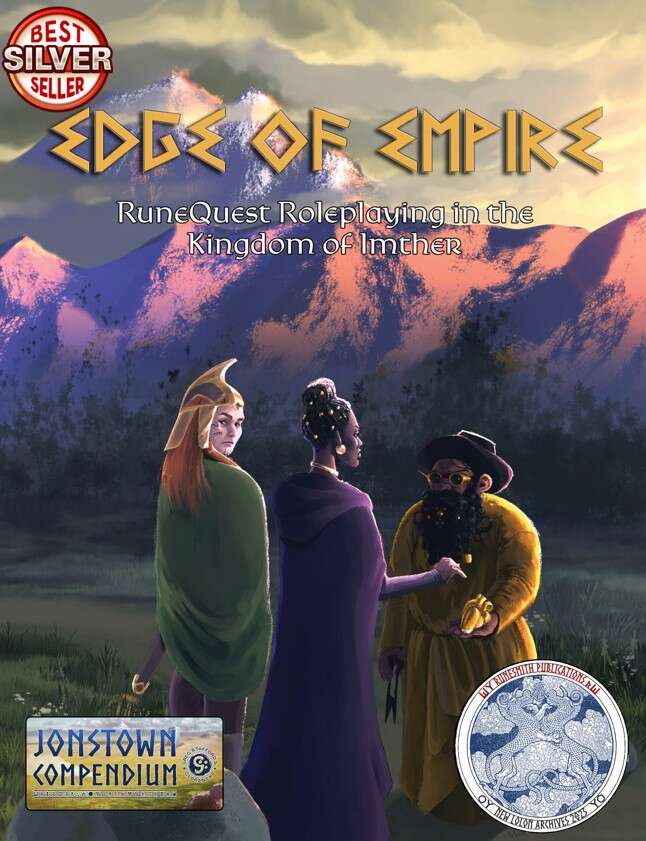
Harald Smith’s debut Jonstown Compendium release contains over 200 pages detailing life in the rustic kingdom of Imther in the Lunar Provinces. Like 2020’s A Rough Guide to Glamour or Secrets of Dorastor, Edge compiles decades of personal fascination and exploration into a comprehensive survey on a single area of Glorantha. Some material was previously published in 90’s fanzines—including Smith’s own New Lolon Gospel, named after an in-world text analogous to the Jonstown Compendium—but the vast majority has never before been available. (Plus, 1990’s RPG fanzines tend to be obnoxiously expensive on the secondary market, and aren’t a “real” solution for getting access to out-of-print material.)
So without further ado, let’s dive on in!
Disclaimer: I don’t think this review contains any spoilers of notable secrets or plot threads in Imther, but I’m not 100% certain. The book is more like a setting supplement than a book of adventures, but I suppose there’s a chance some elements discussed constitute a spoiler.
What’s Inside?
Edge of Empire is an all-inclusive guide to the setting of Imther and the Orlanthi clans of the Imtherian mountains. It contains roughly three multi-chapter topics: an overview, stuff for players, and a gamemaster’s guide plus regional gazetteer. The overview is well-written but pretty straightforward, so let’s focus on the “player stuff” and “gamemaster stuff.”
The player-facing section of the book, to my mind, strongly distinguishes it from similar “campaign setting” books I’ve read for RuneQuest. The core of this strength is that Edge includes not just adventurer creation options, but also guidance for placing the adventurers into a tribe and clan (or inventing your own Imtherian community). Digging deeper than surface-level background summaries and skill bonuses, Smith also includes a questionnaire of “Mythic Events” and “Historic Epics” which allow the players to develop and customize their society. This is in addition to a complete Family History section for creating adventurers set in the standard 1625 st timeline. We have information about wyters, slang, cheeses, and other cultural elements which compliment the rules-mechanical character options to provide an accessible and engaging treasure trove of information which can be used by players at the table. I’m genuinely stunned at how well Smith avoids navel-gazing in this work’s worldbuilding—I often struggle with that myself while putting together background information. By structuring much of the background “flavor” as player-facing advice in the vein of “how to be Imtherian,” Smith makes it feel directly useful to roleplay in a way I feel other RPG supplements could study.
In the same way, the material for gamemasters features a robust combination of useful information and entertaining details. In particular I’d like to highlight the approach to Imtherian spirits throughout the book. This faces the players as each clan’s “seasonal” protective spirit, but to my mind is more prominently part of the gamemaster’s suite of tools. Spirits are detailed for gameplay use through an encounters section with additional detail on specific spirits, as well as frequent mention in the histories, secrets, myths, and ecology of Imther. Edge really gives me the feeling that Glorantha is a magical world in a way that the down-to-earth details of other works (such as the description of Jonstown in the RuneQuest Starter Set) don’t quite hit.
That said, I wouldn’t really say that Edge is targeted at brand-new players. I think it will be accessible for “fairly new” players, but some elements could confuse or frustrate newbies. For example, the shorter myths or background sections are often written in an “allusive” style common to RuneQuest materials. “Dwarfs formally trade the Crystal of Milky Glory … for the Wheel of Stasis” tells the reader little about those artifacts, and I can’t recall their mention elsewhere (Edge p. 95). This style is common in the RuneQuest canon, including in the core rulebook: “The presence of the six- and eight-limbed Atharax creatures and of the humanoid beliyem and kendist people, or the experiences of the playful and destructive uluyum …” alludes to the existence of these entities without really providing playable information (RQG 372).
In Edge—and elsewhere—I have indeed grown to find this style “intriguing” rather than “irritating.” However that is very much a situation in which I’ve grown accustomed to this mode of presenting Glorantha Lore (or non-Lore; in this case I’ve asked and as far as I’m aware the beliyem and kendist have never been mentioned outside this passage?). Thus my opinion that Edge might be puzzling in a way which causes frustration for players unfamiliar with this mode of RuneQuest writing. Fortunately this allusive quality is largely restricted to sidebars or to main text sections describing God Time myths, heroquests, and so on. The bulk of the text is quite detailed without relying on allusion.
And by Khelmal, is that detail glorious!
Yes, you read that right—this book introduces yet another Many Sun. However, Edge doesn’t get into the whole “Elmal or Yelmalio?” debates in the slightest. I applaud Smith’s decision. We’re presented here with a distinct vision of Orlanthi culture which coheres with Cults of RuneQuest while remaining separate. Myths such as the War of the Wall, the role of Khelmal as culture-hero and primary masculine deity, the romantic triangle between the Earth, Sun, and Storm, and the trickster Orlantio develop a vibrant alternative to the canonical portrayal of the Orlanthi. This version of the Lightbringer religion isn’t “opposed to” Chaosium’s vision; the mythology’s basic shape remains the same. Yet so much is reworked in the details that while reading I certainly fell a bit in love with the setting. Khelmal certainly is Yelmalio, but he feels a bit more heroic, more romantic than the “Little Sun” I know. Likewise the Orlanth is definitely the Storm King, but his place among the mountain clans makes him just a bit more rugged, a bit more violent and impolite (certainly appropriate for the owner of the Air Rune!).
This variation is made all the stronger because it isn’t merely the King of Dragon Pass version of the mythology. It feels similar to that video game’s version of the setting (or the rugged vision espoused in Chaosium’s former HeroQuest game line) due to Imther’s rural, mountainous location. Yet this goes deeper than nostalgia for a former version of Glorantha. Edge confidently presents its own version of the Orlanthi.
I do, however, have one fairly substantial frustration with this work: its chronology. The book’s target period is post-Dragonrise like most modern RuneQuest publications. One of the recent major events in the Imtherian timeline is the death of King Margor in 1623 st. The last of his line, King Margor’s death triggers a local succession crisis which threatens to swell into a larger conflict. As new adventurers in 1625 st, the setting seems tentatively set up so that the players can join one of the squabbling factions (or start their own) and navigate the coming troubles.
Yet a lot of the material in this work is written from a more “RuneQuest Classic” chronological perspective. In particular, the political dramas and factions often reference King Margor as an active player in Imther. As presented, it feels like Edge is designed to make characters in one period, but describes the setting as it was in another period. For example, the regional gazetteer is framed as part of the “Lunar Provincial Survey” sent back to the imperial capital. However, this is set in 1621 st. While I understand the choice to provide easier use through emphasizing the modern chronology, blending the two time periods together has left me lacking confidence that I could put together my own Imtherian campaign without additional work collating the sections’ chronology. I feel a similar hesitation about the Earthwielder plot which is seeded throughout the book. On the one hand I understand the deep desire to canonize the campaign which developed the setting. On the other, there’s a dissonance between stating “these are the past feats of the Earthwielder” and “the adventurers can play as the Earthwielder Hero” which I don’t really know how to resolve.
Looking for an adventure set closer to home? The Queen’s Star by yours truly is an adventure set at the Cinder Pits in the Colymar Tribe’s lands. A fallen star begs for help escaping imprisonment in one of the pits—will the adventurers answer his call?
Production
Let me be frank: Edge of Empire is not a beautiful book. However, it’s clear that Smith has devoted time and energy to polishing this work. That energy is simply not “visually pretty” in the way that we often associate with “well-produced” or “high production value” books.
(As a point of reference, I’m reviewing the PDF edition, but I did ensure that I’ve downloaded the most recent PDF prior to reading about a month ago.)
Most illustrations in this work appear to be older scans of line art, often from public domain sources. The art is well-selected, and often includes a sidebar or a caption which helps integrate it into Edge. I’m a big fan of creatively using low-cost or public domain resources (as I think most people who read my stuff probably know). The art is picked and placed well, but the eye tends to overlook this if the image’s resolution is low.
There are, however, a number of delightful color portraits (mostly, I believe, by Rebecca Smith) depicting the various persons of importance in Imther. Likewise the cover is quite good, both in its illustration and in its design. When the image resolution doesn’t jump out, the older pieces also fit well into this book.
On a related note, another reason I do not consider this book “beautiful” is the visual design. I’d not call it “atrocious.” Simply, the default Jonstown Compendium template for Microsoft Word isn’t terribly pretty. Using the template as provided is a reasonable choice, but for prospective customers who care deeply about RPG supplements looking “pretty” this could be a turn-off.
The textual polish is quite good. There are typos or grammatical “infelicities” on occasion. On the whole, though, it’s clear that a lot of attention has been paid to polishing Edge‘s text. It’s proofing quality is easily equal to Chaosium’s recent releases, and strikes my subjective scale at just a bit above my “indie average.” I also want to compliment Smith’s pagination. It’s infrequent that a paragraph will continue from one page to the next. Sections close succinctly, and page space is typically filled well by sidebars, illustrations, or both. Good pagination is often difficult to notice as a reader—it disappears into the reading experience—so I wanted to make sure I acknowledge the effort put into that work.
Overall, it’s clear to me that an awful lot of energy was put into refining Edge on both “production” and “content” levels. Saying that Edge isn’t beautiful is not an indictment of the book or its creator in this case. Rather, Edge is a fantastic example of how a new Jonstown Compendium creator might produce a work of salable visual quality without breaking the bank on art investments.
Conclusion
Edge of Empire is a compelling campaign setting for RuneQuest. It has nearly everything a gamemaster needs to run a campaign in a single package. Really, the only stuff in particular which seems missing is, y’know, the actual RuneQuest rules slipcase. (Edge does have a solid mix of new antagonist statblocks, but you’d want the Bestiary for variety; the included stats are supplementary, not all-inclusive.) Honestly, when Chaosium releases their Sartar campaign setting book (Homeland book?) I think Edge will be my point of comparison. Smith’s shown he’s capable of both conceiving of and executing RuneQuest projects of remarkable ambition.
Scoring for these type of reviews is, honestly, a real pain. I’d much rather just post the article and move on. However, as a creator myself I understand how helpful it is to have actual reviews on DriveThruRPG, so I keep putting these up there as well. Mulling it over, I’ve decided to give Edge of Empire a 4 out of 5 because I feel the inconsistent chronology does impact how useful the book is as an all-in-one campaign setting.
That said, this is absolutely worth its price. Edge of Empire is available in the following formats:
- PDF: $19.99
- Print on Demand: $38.99
The solid polish and sheer length of this product definitely make it worth the price tag. More than worth, honestly, by a long shot. Edge is easily worth $30 or more in PDF, to my mind. I want to explicitly note that the production quality has not reduced this product’s score. The visual and textual polish are entirely appropriate for the price point. I’ll gladly pay for a product which ensures the author’s getting paid for their effort to write it! (I swear, one of these days I’ll get around to writing my Jonstown Compendium pricing soapbox essay …)
I recommend this book mostly to people familiar with RuneQuest, but looking for something a bit different (or looking for a more complete setting than that currently available from Chaosium). This does not include “you need to be a Glorantha Expert” level complexity, but I do encourage a bit of experience with the system and setting.
Six Seasons in Sartar is a good comparison, I think. It’s a great story and gameplay experience for new players, but I feel it’s best that the gamemaster already has some RuneQuest experience. Edge is a great setting, but you’ll get the most fun out of it if you’re already familiar with how RuneQuest and Glorantha tend to “logic.”
Want to keep up-to-date on what Austin’s working on through Akhelas? Go ahead and sign up to the email list below. You’ll get a notification whenever a new post goes online. Interested in supporting his work? Back his Patreon for early articles, previews, behind-the-scenes data, and more.
You can also find Austin over on Facebook, and increasingly more often on Twitter.
 Akhelas