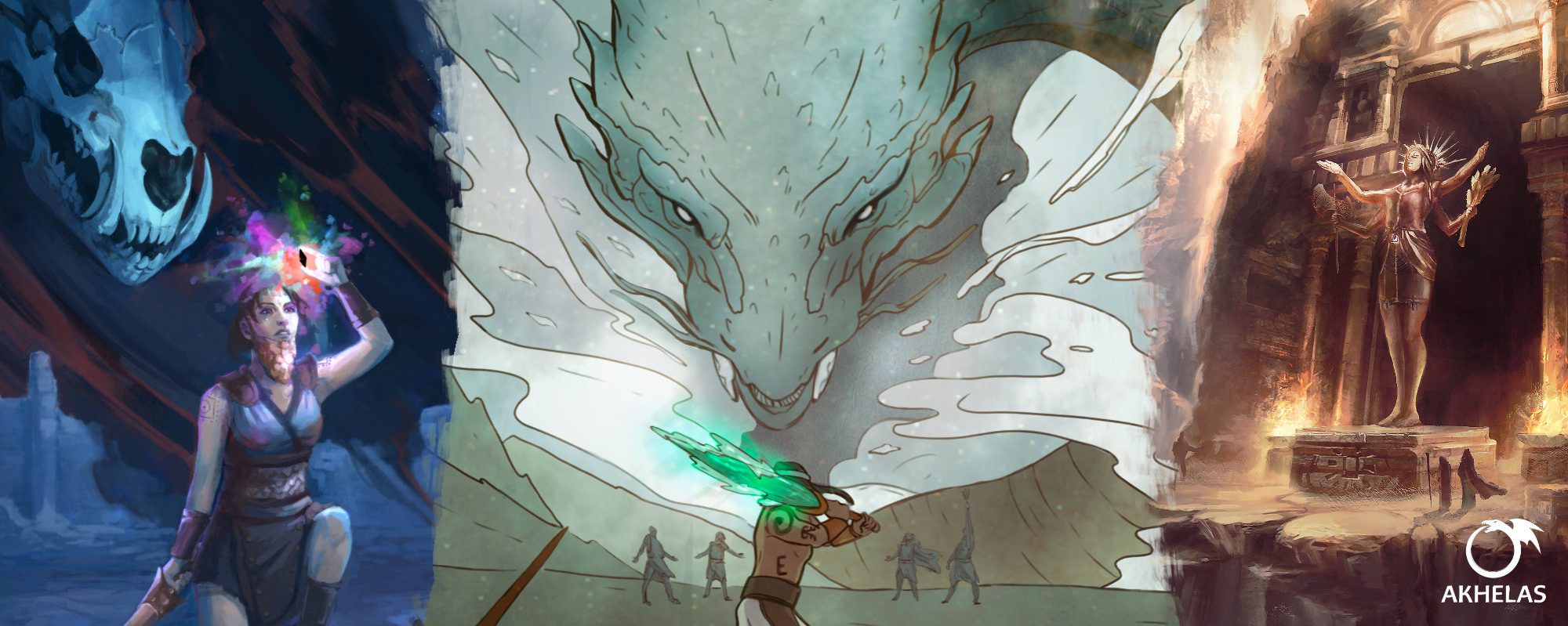
Earlier this year I returned to writing publicly about this site’s namesake: Akhelas, the First Land. This is the primary region within which I write fiction about the Endless Lands. Previous posts have discussed Creation and humans. I’ve been in a metaphysical mood of late, so let’s chat magic.
Some Foundation
The nature of magic in the Endless Lands is a topic I’ve wrestled with for some time. There are two basic metaphysical challenges: uniformity, and monism. The Endless Lands are wildly, impossibly diverse. One goal of the cosmological structure is that an enormous—verging on infinite—diversity of possible world-structures, landscapes, cultures, sentients could be presented. I have no need to describe the whole Endless Lands, but I love the idea that someone else might explore their version within the same Vessel. This variety intersects with the setting’s eschatological conflict between Light and Void. Infinite (or near-infinite) expansion and variety are necessary for Creation to continue as an ongoing process resisting the Void.
The substance of all this, however, is the Light. The Endless Lands are substantively monist. Monism is the doctrine that there is basically one type of substance (in contrast with dualism, which typically holds that there is both physical and mental substances). This monism is necessary due to the initial process of Creation. At the rough equivalent of an “atomic” level, the Endless Lands are made from Light. This is a little obscure to those of us not in the fictional world, and likely extremely obscure to the Half-Made inside it.
This substantive monism logically requires universally consistent metaphysics. If the constituent matter of reality is one, then its description must be uniform. By unifying the Vessel’s metaphysics I provide a uniform structure within which Lands can be discovered. This is analogous to the frame in which a painting is hung on the wall. The viewer’s focus is the artwork—but the frame structures what is seen.
Alright, I believe we’re out of the ontological weeds. If you want to speculate more on the Endless Lands’ metaphysics, I suggest reading Plato’s Timaeus.
Why Metaphysics Matters
Now, you might very reasonably ask why I shoved a bunch of philosophy jargon down your throat. After all, this article is supposed to be about magic!
Trivially, that’s just who I am as a writer and thinker. It’s how I approach the topic.
A less trivial answer is that a fantasy setting’s metaphysics, its “deep rules” about the world, is intrinsically connected to its magic. If it’s possible to summon a demon from Hell or an angel from Heaven, that magic has both cosmological and metaphysical implications. Of course, it implies that Heaven and Hell exist in that setting as separate “planes” (borrowing the term from Dungeons & Dragons) of existence. It also implies substantive pluralism. There is a substance which is Earth, and at least one which is “elsewhere.” In most cases, this would require a minimum of three substances (Earth, Heaven, Hell) but there’s lots of conceptual playground available.
Most fantasies consider cosmology, but don’t consider metaphysics. This is an error because the means through which magic operates are generally metaphysical, not physical. Magical actions in fantasy circumvent physical understandings of the world. A wizard creates fire not through friction or a spark, but by manipulating something other than substantial matter. For example, in The Wheel of Time channelers guide threads of the One Power into weaves of different elements. They act as a bridge between the physical world and the Power. Weaving these threads into specific patterns, essentially, creates spells. One reason The Wheel of Time remains a compelling fantasy is that it provides a metaphysical explanation for magic without distilling it entirely into a “fantasy science.”
The Vessel’s substantive monism made thinking about magic challenging because most fantasies rely upon a dualism for the operation of magic. In Glorantha, this is interaction with myths, gods, and spirits in another world. Brandon Sanderson’s Stormlight books explore magic as a result of the Physical, Cognitive, and Spiritual planes interacting with one another. Lacking another “plane” for magical interaction, the structure of magic needs to look a bit different.
The Elements
In my current conception of the Endless Lands, there are three basic elements which structure a magical process: Soul, Law, and Will.
Soul is the “fuel” of magic. It is the investment of a person’s creative, life-generating energies into a magical process. Sometimes this investment is a permanent loss of self, and other times it is simply channeling one’s mental and physical energies (like calories, basically). Soul replenishes, grows, expands, and is mobile. It is generated through creative activities. So long as the Vessel generates more Soul than the static rate of the Void’s entropy, the universe will remain expanding and stable. Soul is not “lost” when used in magic—it simply moves throughout the world.
The flow of Soul is governed by Law. This is a mental structure created by an entity within the Vessel which governs the motion of energy. The Laws created by the Nine are those which structure the universe. The process is the same for Half-Made engaging in magical activity (albeit on a much, much smaller scale). A Law is created through an investment of Soul. While a specific Law is inflexible, more generally the exact shape a Law can take is highly variable. This preserves the variety of magical action.
The effectiveness of magic depends upon the user’s Will. This is the least strongly conceived of the three elements, currently, in my thought. It can most easily be imagined as visualization of the effect. Law creates the structure which allows Will to shape Soul into magic.
As an analogy, consider a flashlight. Soul is the battery, Law is the power button, and Will is the lightbulb.
Interested in how these elements shape the use of magic on Akhelas? I enjoyed writing this out, so I’ll continue in this vein next week. We’ll look at the macrocultures of Akhelas, their magical traditions, and how the use of magic impacts their perspective on both the world and one another.
Until next week, then!
Want to keep up-to-date on what Austin’s working on through Akhelas? Go ahead and sign up to the email list below. You’ll get a notification whenever a new post goes online. Interested in supporting his work? Back his Patreon for early articles, previews, behind-the-scenes data, and more.
You can also find Austin over on Facebook, and a bit more rarely on Twitter.
 Akhelas
One thought on “Three Elements of Magic”