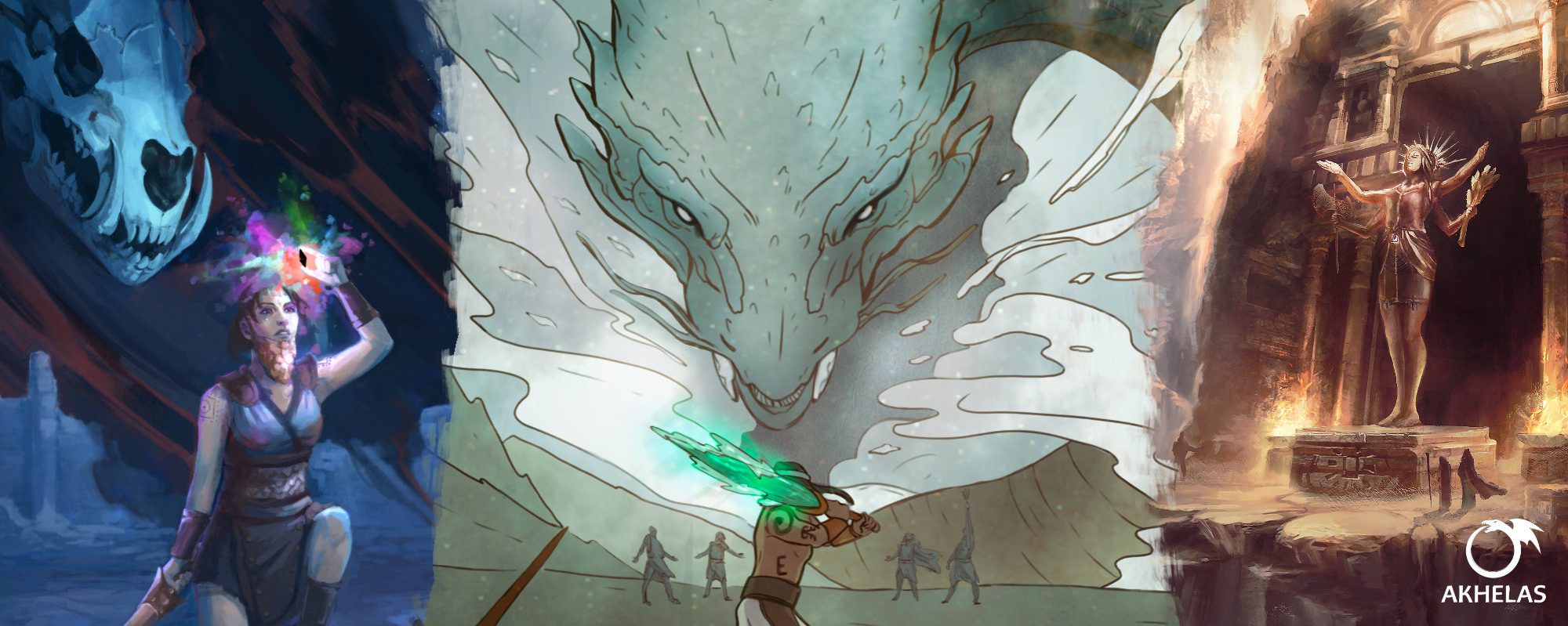
[Tosti Runefriend] quested to climb the primeval Spike, seeking the secrets of the Runes from the very feet of the Celestial Court.
Glorantha Sourcebook, page 44, “Companions of Argrath”
In Glorantha’s mythology, the Old Gods are those early deities of creation which are recognized as fundamental aspects of the cosmos. However—like Ouranos of Greek mythology, or Tiamat of Babylonian mythology—they don’t really receive substantial worship by living humans. Some, like Umath the Primal Air, were slain during the Gods War. His powers descended to his children, most famously Orlanth. Others, such as Gata the Primal Earth, exist “forbidding and formless” in a sort of Lovecraftian space beyond what humans can comprehend (Earth Goddesses 9).
The most well-known group of these ancient deities is the Celestial Court which ruled the Golden Age before strife, war, and Death. Other “elder gods” exist beyond the Court, such as Ouroboros, the Invisible God, or Glorantha herself. The further an adventurer reaches beyond the major deities of the Third Age, they brush against increasingly massive and obscure existences. Again, the Cthulhu Mythos is a useful analogue. The Old Gods aren’t Chaotic monstrosities from beyond the veil, but they do seem presented as incomprehensible to human experience. Can dirt be good, or evil? No. The substance is simple—it’s dirt—but it is also essential to the existence of life. In Glorantha, dirt is Gata.
If you want to learn more about the Celestial Court, go check out Mythology or the Glorantha Sourcebook.
Today’s topic isn’t “Old Gods 101.” Rather, we’re going to play around with the Old Gods in our speculative sandbox. In the fine YGWV tradition—”Your Glorantha Will Vary”—right now I’m not interested in Stafford’s or Chaosium’s Glorantha. I want to play with Conrad’s Glorantha. This doesn’t mean I’m not going to reference or intuit from the work of other RuneQuest writers. Being “right” about the mythology just isn’t that important to me today.
If you think there’s a cool idea here, steal it and let me know how it plays! I have no interest in clutching Conrad’s Glorantha to my chest like a Titanic bourgeoise’s pearls. Use what’s fun, abandon the rest.
Who are the Old Gods?
The High Gods of Vithela … are the creators of the cosmos. They are worshiped primarily by the gods and ignore mortals.
Prosopaedia, page 12, “Avanparloth”
In my Glorantha the Old Gods are as distant from the living gods (ex. Orlanth, Krarsht, Godunya) as the living gods are from a typical adventurer. There’s a chain of relationships which extends from mortals within Time all the way to mysterious entities like Arachne Solara and non-existent entities like Akhijikin. Texts get more frustrating and more obscure the bigger you get, because even within the context of a fantasy tabletop game cosmology starts flirting with ontological concepts.
(Geeky aside: Basically, as a philosopher I tend to think there’s stuff we can rationally conceive and think about, but which language can’t express in a semantically meaningful way. That’s why the great philosophers say gobbledygook like “the All is the One” or “being qua being” as if it makes sense in everyday language. But today’s sandbox is Conrad’s Glorantha, not Conrad’s epistemology.)
Two useful examples for looking at this are the “Avanparloth” recognized in the Gloranthan east, and the “Greater Entities” of RuneQuest shamanism. In essence, Avanparloth is another synonym for Old Gods, Elder Gods, High Gods, etc. As noted in the above quote they receive worship from gods, not mortals. In turn, these High Gods worship an entity called Atrilith (Prosopaedia 12), which is basically the One, the Invisible God, Ouroboros, or some other enormous ambiguity. We see here a Malkioni-style chain of veneration which runs:
Mortals → Gods → Old Gods → the One
There’s lots of space here for qualitative and experienced differences internal to a particular Gloranthan religion (such as the Lightbringer religion or the Glorious Ones of Fonrit). In my Glorantha these shared structural relationships describe the mythology without invalidating the subjective experiences of particular viewpoints. As RuneQuest players, we call these viewpoints “magic systems.” Spirit magic, Rune magic, sorcery, and so on—as the Guide notes, these paths are dominant but other undescribed magic systems exist (page 9).
the Problem of Uleria
Now, there’s a significant exception to this structure—Uleria, the Goddess of Love. This Old God’s cult describes her as “the Ancient Cup from which the whole world was poured at the dawn of creation.” Unlike other Old Gods, Uleria continues to have a cult among mortals. Why?
In my Glorantha this is due to a type of enlightened experience, Illumination, which was taught by the famous sages of the God Time. Our core Dragon Pass area calls them Rashoran (better known in his reincarnation, Nysalor). In the east, these sages are Mashunasan. I’m using plurals because specific names and individuals are unimportant. The key piece is that, as the Gods War intensifies, sages appear throughout Glorantha spreading enlightenment.
The results of [Rashoran’s] teaching varied. Most of the deities … succumbed to the Darkness without a struggle shortly afterwards. A few were fortified, such as Humakt and Uleria …
Mythology, page 44, “The Unholy Trio”
The most consistent result of enlightenment in RuneQuest is circumventing the normal magical structures of Glorantha. Naturally, the player-favorite Illumination ability is dodging a cult’s Spirit of Reprisal. This gives the player opportunities to break taboos, learn forbidden magic, and generally have a really fun time until they’re caught. One consequence of Uleria’s Illumination is that she is not restricted by this loose chain of veneration like most of the Old Gods. Uleria is even able to bridge the distance between mortal and the “Eternal Moment of Allness that lies beyond Harmony” (Earth Goddesses 129). We see this present in RuneQuest terms through her spell Erotocomatose Lucidity.
Gods like Uleria are what I think of as “Fallen Gods.” (Not sold on that category.) This roughly gathers those deities which have some additional weirdness going on involving their place in my Glorantha’s cosmology. Illumination or other “flavors” of enlightenment are common among the Fallen Gods, but that cause is not universal. Now, I don’t think any adventurers really imagine their world this way. This is how I conceive Conrad’s Glorantha from the outside because it’s useful to me as a writer and a gamemaster. Another two interesting Fallen Gods are Humakt and Chalana Arroy.
In my Glorantha, the Death God Humakt is not merely a son of Umath who attained power as the first god to wield Death. I see Humakt as a broken remnant of Kargan Tor. This is the primal Death Rune—or perhaps Separation Rune—which was a member of the Celestial Court. My Humakt is a surviving Old God with all the baggage that entails. Illumination gave Kargan Tor the foresight to overcome his Honor and abandon his post guarding the Spike. Kargan Tor recognized the pattern of Umath separating the Sky from the Earth. An act of catastrophic Death was needed for the cosmos to have any chance of defeating Chaos. Unlike Uleria, Kargan Tor still was forced to go against his nature, and so was diminished. Unlike the rest of the Celestial Court, Kargan Tor lived through the destruction of the Spike. He became the deity now called Humakt.
Chalana Arroy’s origin is a bit mysterious. The Goddess of Compassion is described as a daughter of Glorantha herself. She lacks the somewhat elaborate genealogy of most living deities. Chalana Arroy is the current “owner” of the Harmony Rune—a concept I, actually, find somewhat dubious in general—and much like Uleria is a hyperlative example of that Rune’s values.
In my Glorantha, Chalana Arroy is a “Fallen God” really in a straightforward way. She’s a fragment of Glorantha. Most fragments of this Elder God are definable pieces of the world. Umath was a fragment of Glorantha, and Orlanth still is, in the sense that “Glorantha” denotes the universe, all of the stuff in one bucket. Chalana Arroy sticks out because unlike those deities she is defined by her relationship with Glorantha-as-goddess. Chalana Arroy is Glorantha’s mind, her personality. She’s a sister of Ginna Jar (Glorantha’s power, without mind), and probably an aunt or half-sister of Time.
(I’m not really sure where Arachne Solara fits into my cosmology. I’m inclined to think she is Time, and created herself by eating Kajabor the Devil before her birth. Structurally her position is a bit more like the One than an Old God, so the point is pretty irrelevant.)
Humakt and Chalana Arroy are pieces of the Old Gods which have, one way or another, managed to survive as essentially themselves. They are Fallen Gods because they’re in some sense diminished. Uleria’s place in this space is a little more artificial because she doesn’t seem diminished in the same ways. All possible acts of unification and love are Uleria within the world; not all separations and deaths are Humakt. Glorantha diminished by the law of the Twins, and Chalana Arroy is far less than that cosmic entity which could even integrate opposites within itself to encompass the entire Celestial Court.
Next Time
Looking back over what I’ve written so far, it feels reasonable to split this article in half at this point. So next week we’ll return to the topic of the Old Gods, and how I engage with them not just in this theoretical way, but as entities you can introduce into a RuneQuest game. They mostly loom in the background, but I do think adventurers can interact with the High Gods to gain magic.
How do you get magic that only responds to the worship of gods? Honestly, that’s actually really easy.
Just become a god yourself.
Want to keep up-to-date on what Austin’s working on through Akhelas? Go ahead and sign up to the email list below. You’ll get a notification whenever a new post goes online. Interested in supporting his work? Back his Patreon for early articles, previews, behind-the-scenes data, and more.
You can also find Austin over on Facebook, and a bit more rarely on Twitter.
 Akhelas
3 thoughts on “The Old Gods in RuneQuest, Part 1”